Back
Global Template Rationalisation & Optimisation: The Business Case for Contracting Performance Infrastructure (Part 2)
5 minutes • 23 Sep 23

The Compounding Economics
A legal opinion is usually consumed by the matter for which it was commissioned. A well-engineered template can be used hundreds or thousands of times, while its marginal cost of reuse remains low.
This creates the first compounding effect. If an improved template saves USD 2,500 each time it is used and supports 2,000 annual transactions, it creates USD 5 million of annual transaction value before accounting for faster revenue, protected entitlements or avoided disputes. The asset does not require complete reconstruction in the following year, although it should be governed and maintained.
The second compounding effect arises through adoption. As confidence in approved templates increases, unofficial variants and workarounds reduce. More transactions move through the intended pathway, and a greater proportion of the theoretical benefit becomes realised performance.
The third effect arises through technology. Standardised content supports document generation, self-service and workflow. Those capabilities create consistent data, which supports analytics and AI. Better intelligence can then identify further sources of friction, recurring deviations and value leakage. Each layer depends upon the quality of the layer beneath it.
The economic question is therefore not limited to project cost. It includes how often the resulting capability will be used, how widely it will be adopted and which additional capabilities it enables. The investment is finite, but the asset continues to produce and expand its return.
Where an initial phase addresses a high-volume contract type, the programme may become substantially self-funding. Early transaction savings can finance later rationalisation, while each completed asset continues contributing value during the wider rollout. Economically, the programme behaves more like an investment in reusable infrastructure than one-off advisory expenditure.
Global Standardisation and Localisation
A multinational organisation operating in 30 countries may initially assume that each agreement type requires 30 country versions. In practice, that multiplication is rarely justified.
Most business-as-usual transactions share a substantial common legal and commercial core. Material jurisdictional differences tend to concentrate around identifiable issues that can often be addressed through controlled local modules, drafting notes or approval requirements. A limited number of outlier jurisdictions or transaction types may warrant separate documents.
The appropriate architecture is therefore:
◼️a common global or regional core;
◼️jurisdiction-specific intervention limited to identified requirements;
◼️modular clauses or schedules where variation is required; and
◼️separate documents only for genuine outliers.
This approach reduces the number of assets, simplifies governance, aligns risk positions, lowers maintenance cost and improves technology readiness. It also avoids distorting the global template to accommodate an exceptional legal regime that applies to only a small part of the portfolio.
The distinction between common-law and civil-law systems does not, by itself, justify separate template families. Nor should the phrase local market practice conclude the analysis. The relevant question is whether a difference in law, regulation, enforceability, commercial convention or organisational risk appetite requires the contractual outcome to change.
Local law validation remains a risk-based decision. Full law-firm sign-off supposedly offers the greatest external assurance, but few organisations operate without considering proportionality before committing legal spend.
The appropriate model may range from comprehensive external review to targeted validation of identified issues, supported by internal expertise and disciplined research. The organisation should select that model consciously, by reference to the transaction, jurisdiction, exposure and governance expectations.
The sophisticated position is not that localisation is unnecessary. It is that localisation should occur only to the extent that genuine legal or commercial differentiation requires it. Everything else adds avoidable complexity to the global estate.
GLS examines this methodology in greater detail in its paper How to Effectively Produce Global or Regional Contract Templates.[3] The central conclusion is important for the present business case: global complexity does not reduce the value of standardisation. Properly engineered, it increases that value.
Standardise Before Automating
CLMS, workflow tools, document automation and AI require stable content and defined decisions. A fragmented estate does not provide either.
Where templates contain competing structures, inconsistent positions and uncontrolled exceptions, the organisation must either resolve those differences before implementation or encode them into the system.
The second option increases configuration, testing, maintenance and user complexity. It can also weaken analytics because apparently comparable data arise from documents that do not mean the same thing.
A CLMS does not create standardisation. It assumes that the organisation knows which templates, clauses, variables, approvals and deviations the system should govern. AI can assist with classification and review, but its output is more dependable when the source documents use consistent language, metadata and clause architecture.
Standardisation should therefore precede material automation. This sequencing protects technology investment, accelerates implementation and reduces the risk that a sophisticated platform becomes a controlled repository for unresolved inconsistency.
The same principle applies to future technologies. The organisation does not need to predict every tool it may adopt. It should create clean, modular and well-governed contracting assets that can be adapted without fundamental redesign.
Why Internal Template Projects Often Stall
The apparent simplicity of a template project creates a recurring execution problem. Organisations assume that capable lawyers can improve the documents alongside their normal workload. The legal drafting is rarely the principal obstacle.
These initiatives require the organisation to resolve ownership, risk appetite, commercial policy, global and local authority, user needs, process design, data structure, governance and adoption. They also require participants to surrender familiar language, inherited practices and, in some cases, local control.
Internal projects therefore encounter predictable pressures:
◼️individual drafting preferences are treated as material requirements;
◼️jurisdictional difference is raised before the common core is established;
◼️seniority influences decisions that should be determined by evidence and design criteria;
◼️consultation expands without clear decision rights;
◼️risk conservatism favours retention of every existing protection;
◼️business users enter after Legal positions have hardened;
◼️project work competes with urgent business-as-usual matters;
◼️ownership is shared, but accountability for completion is unclear;
◼️perfection is pursued before a usable standard is deployed; and
◼️adoption is deferred until drafting has concluded.
None of these conditions implies weak lawyers or poor intent. They reflect the environment in which internal teams operate. Lawyers are trained to identify nuance and protect against exception. They are also accountable for current transactions, which makes immediate delivery more visible than the long-term return from infrastructure work.
Individual lawyers understandably optimise individual documents. Rationalisation requires someone to optimise the contracting system.
Successful projects establish the shared core before addressing difference, define decision rights before broad consultation, and use evidence to distinguish legal necessity from preference. They design adoption, governance and measurement alongside the documents, rather than treating them as later implementation tasks.
Legal Operations Led Performance Engineering
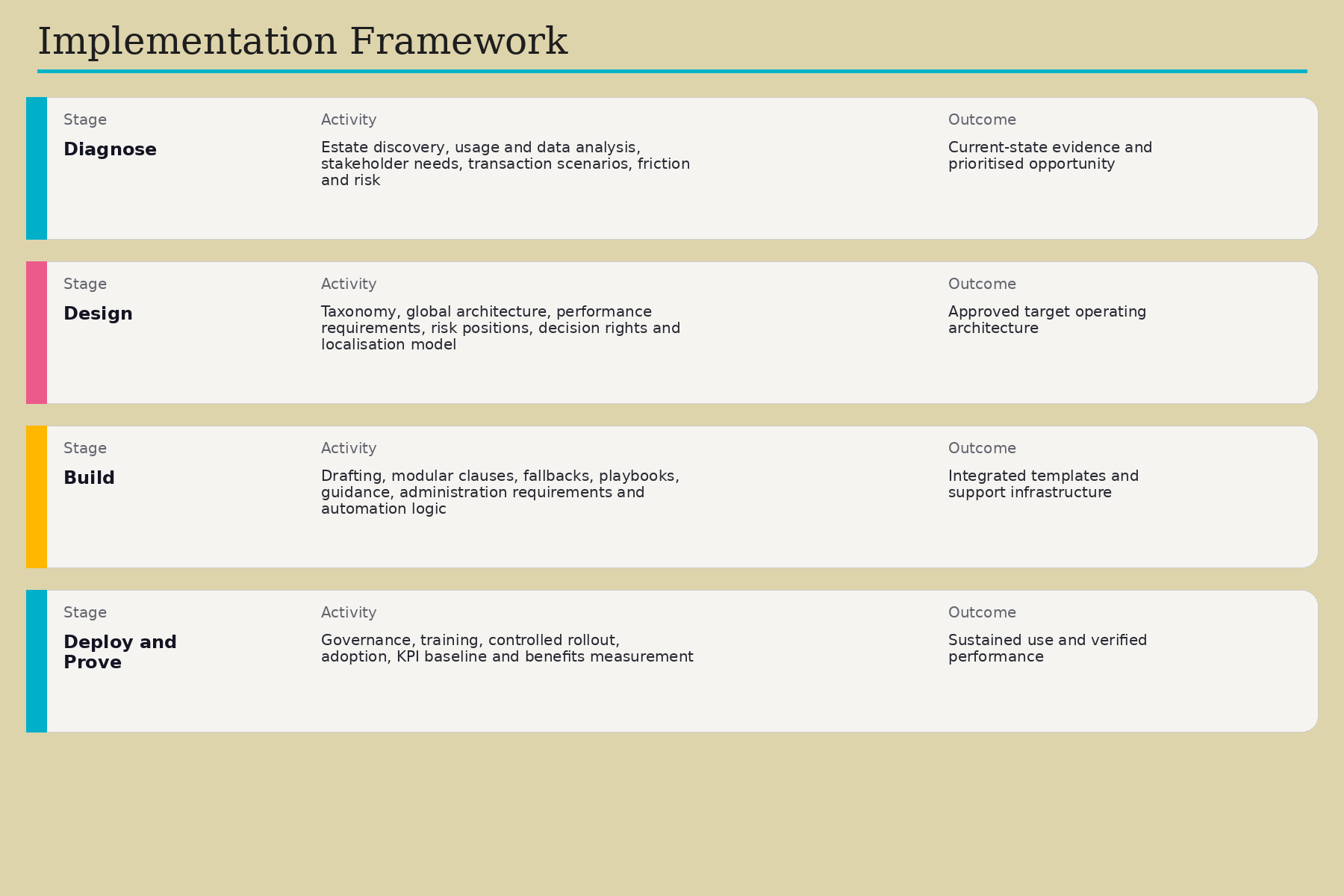
A Legal Operations-led project begins with the performance the organisation requires. It then engineers the contracting architecture, documents and supporting tools backwards from those outcomes.
The method asks a different opening question. Instead of asking which templates Legal wishes to redraft, it asks which contracting scenarios the organisation must support, what performance each scenario requires and what infrastructure will produce that performance consistently.
The work can be organised into four connected stages.
An externally guided process can provide neutral structure where internal hierarchy, local ownership or historic practice would otherwise dominate. It can also bring methods and tools that reduce the demand placed on busy subject-matter experts. External guidance should not displace the judgment of the organisation's lawyers or commercial leaders. It should organise that judgment so that decisions are reached efficiently and applied consistently.
The performance-engineering discipline also prevents unnecessary infrastructure. More clauses, more templates, more process and more technology do not necessarily produce greater control. The objective is a proportionate environment that gives users the minimum assets and decisions required to achieve the maximum sustainable outcome.
This is the basis of the GLS Gold Standard approach. It combines template architecture with negotiation logic, business decision support, lifecycle administration, governance, data and measurement. The organisation buys an engineered performance outcome, rather than a quantity of drafting hours.
Proving the Investment Worked
Template rationalisation should be approved with an explicit benefits framework. The organisation should establish a baseline, define the intended future state and measure performance after deployment.
The appropriate measures will vary by contract type, but a balanced framework should cover four areas.
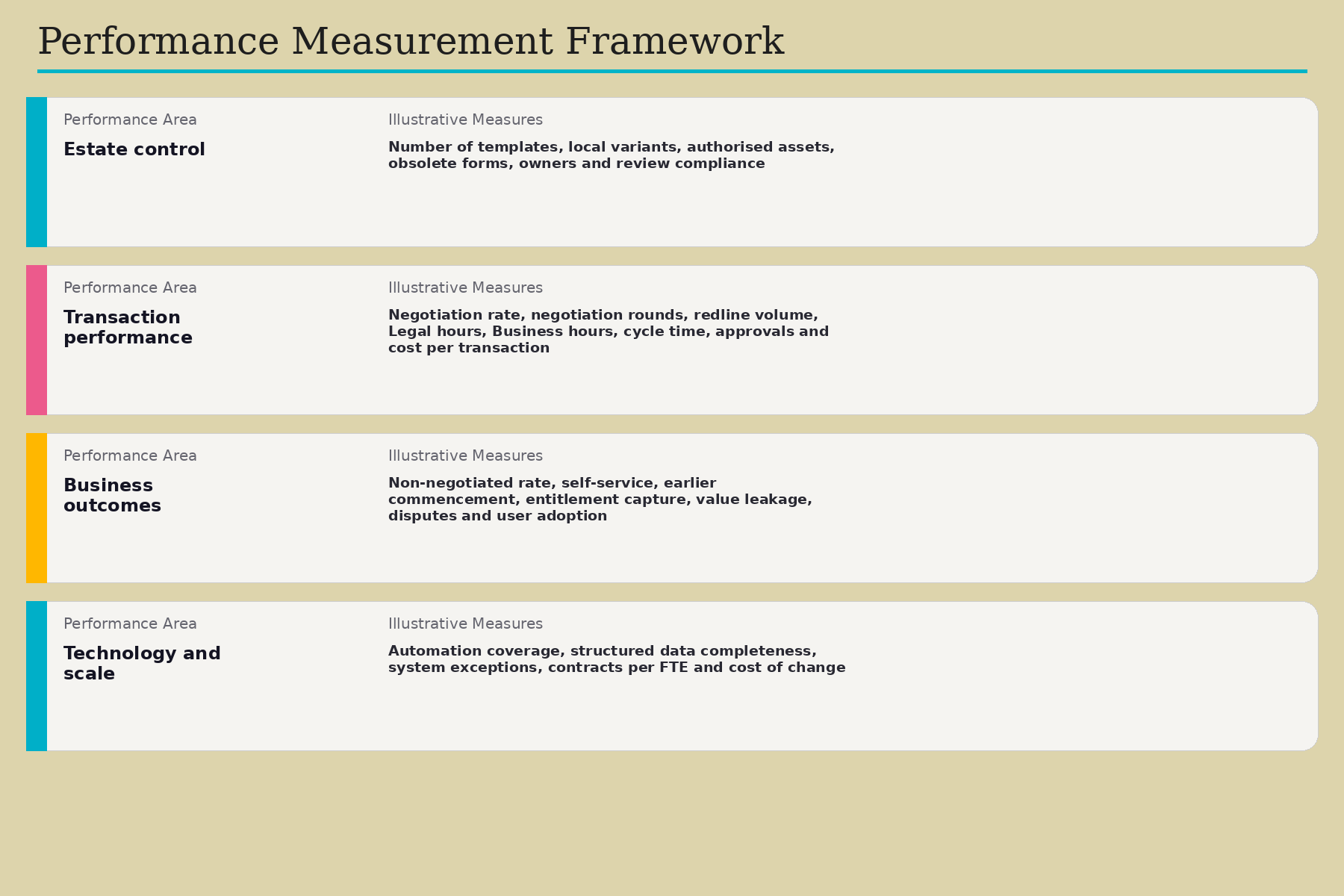
Measurement should separate leading indicators from realised outcomes. Approved template adoption and reduced escalation can be observed soon after deployment. Dispute incidence, value recovery and technology benefits may require a longer measurement period.
The organisation should also distinguish between different forms of economic return. A reduction in external counsel produces an identifiable cash benefit. Internal time released may initially create capacity rather than reduce headcount. Faster signature contributes financial value only where it changes revenue, mobilisation or another business outcome. These distinctions increase confidence in the business case.
Benefits should be assessed at transaction level and then aggregated by contract type, business unit or jurisdiction. This allows management to identify where the design is working, where adoption remains incomplete and where further intervention will generate the greatest return.
Unlike many transformation programmes, the operational consequences of template rationalisation can be observed directly. The organisation can determine whether transactions became cheaper, faster, less negotiated, more consistent and easier to administer. If the expected improvement does not occur, the data should identify whether the problem sits in design, adoption, governance or process.
The Cost of Doing Nothing
Maintaining the current template estate can appear costless because it does not require a new project budget. That appearance is created by the way existing costs are distributed and absorbed.
The organisation continues to pay through recurring transaction effort, lost capacity, delayed business, inconsistent risk, unmanaged variants, avoidable negotiation, missed contractual value and manual administration. It also carries a future cost when technology implementation must first remediate the content and decisions that the organisation postponed standardising.
Delay can make the project harder. New local variants are created, further drafting preferences become embedded, data remain inconsistent and user confidence in the official estate declines. Each year of additional contracting can enlarge both the inventory and the institutional resistance that later rationalisation must address.
The status quo should therefore be assessed on the same basis as the proposed investment. Its cost should include the annual Contracting Friction Tax, the opportunity cost of unreleased capacity, the value of delayed improvement and the effect on planned technology investment.
Once those current-state economics are visible, maintaining the existing environment becomes the option requiring justification. The burden should not remain entirely upon the case for improvement while the recurring cost of inaction is treated as neutral.
The Investment Decision
A multinational organisation will contract whether or not it rationalises its templates. It will employ lawyers, consume business time, negotiate risk, administer obligations, preserve or lose commercial value and increasingly invest in contracting technology.
The decision is therefore whether those activities will continue to operate through fragmented and inconsistently engineered assets, or through infrastructure designed to improve their performance.
A proportionate decision can be made by answering five questions:
◼️Which high-volume or high-value contract types create the greatest friction or leakage?
◼️What proportion of current negotiation can be removed or materially reduced?
◼️What Legal, Business and external cost is attached to those transactions?
◼️Which commercial, risk and technology outcomes depend upon better standardisation?
◼️How will the organisation verify the return after deployment?
The initial step need not be a global drafting programme. A focused diagnostic can establish the template inventory, transaction pathways, current cost, performance constraints and priority opportunities. That evidence allows the organisation to sequence investment and prove value before expanding the model.
The resulting capability has unusually attractive economics. A well-engineered global template estate is built once, maintained intelligently and used repeatedly. It reduces current transaction cost while creating the foundation for self-service, automation and better commercial intelligence.
The investment is finite, while the returns recur across future transactions and the capability available to the organisation continues to grow.
MATTHEW GLYNN: DIRECTOR – GLS GROUP
Matt Glynn is Managing Director of GLS Group and a globally recognised legal operations and legal transformation specialist with more than 20 years at the forefront of legal industry disruption.
He is the author of The Ultimate Guide to Legal Operations, has published 200+ articles on legal department performance and has developed hundreds of technology-enabled legal department assets.
Matt was the chief architect of the GLS-DLAD Legal Operations Certification, the Middle East’s first government-approved legal operations certification, and created GLS’s first-of-its-kind Legal Transformation Tube Map.
Through GLS, he has built one of the world’s most extensive legal operations intelligence and implementation platforms, helping in-house legal teams globally achieve materially better performance with fewer resources.
You may contact Matt at matt.glynn@gls.global

The GLS Legal Operations Centre
Register to access your complimentary Day 1 Resource Stack packed with legal team performance resources.

GLS Ultimate Guide To Legal Operations
Download this and read it thoroughly and regularly. It is a wonderful transformation companion.

Book A No-Obligation Consultation
If you would like discuss your legal transformation needs, please book a 30 minute free consultation with us.

GLS Legal Transformation Boot Camp
Our hugely successful, 10-week long, email-based boot camp on how to effectively transform your legal team.