Back
Global Template Optimisation: Designing for Performance – Outcomes, Requirements and Measures of Success (Part 1)
5 minutes • 23 Sep 23

Introduction
A template can be legally excellent and commercially expensive - every time it is used. It can protect the organisation while slowing revenue, consuming unnecessary management time and making routine transactions dependent on Legal. It can secure valuable rights that nobody exercises. It can survive detailed legal scrutiny and still perform poorly for almost everyone required to use it.
That is the opportunity a conventional template update can miss – particularly those conducted by internal legal teams – typically around the edges of their already busy day. Our data shows that most legal teams still approach global template update projects primarily as a legal drafting exercise. Yet templates help determine the speed, cost, control and commercial effectiveness of contracting. Those results are shaped by design choices, whether or not anyone consciously makes them.
Every transaction carries a cost. Avoidable complexity, negotiation, delay, escalation and lost contractual value add a further burden: the Contracting Friction Tax. Increasingly, organisations can quantify that burden and engineer a substantial part of it out of their contracting environment.
The opportunity to start performance engineering legal templates is particularly timely. Businesses need to move faster with constrained resources, while contracting technology and AI create capabilities that depend on coherent documents, decisions and data.
This intelligence paper examines why template projects so often underspecifies the performance outcomes a better template environment should support,and connects those outcomes to practical design requirements and measures of success. The papers’ central premise is this: if you want better contracting performance, specify it before anyone starts drafting.
The performance opportunity hiding inside a drafting project
In 2025 alone, GLS received more than 35 global template RFPs. They offered a useful view of how organisations define these projects before the work begins.
Most identified the documents to be updated, the jurisdictions in which they would operate and the expected localisation work. Many also referred to better business use and reduced demand on Legal. Few explained how those outcomes would be delivered or what evidence would show they had been achieved.
We did not see requirements to determine:
◼️Which transactions should proceed without Legal involvement;
◼️Which should no longer require negotiation;
◼️How much faster contracts should close or renew; or
◼️How transaction cost and the recovery of contractual entitlements should improve.
The externally resourced project therefore acknowledges a performance opportunity, but often commissions a document update without specifying the operating changes the new documents must produce.
Internally resourced projects face a different pressure. Limiting external expenditure can make the exercise appear economical, while involving lawyers across the organisation creates a welcome opportunity to draw on their experience and local knowledge. Both are sensible instincts. Neither, by itself, supplies a performance brief.
Lawyers invited to review templates will comment on them. They will identify real legal issues, but they will also bring different drafting preferences, familiar protections and views about what their jurisdiction requires. An inclusive process can create pressure to accommodate more of those comments than the intended use of the template justifies.
Without agreed performance requirements and clear decision rights, each proposed addition tends to be considered on its own merits. Protections expand, qualifications accumulate and local variants gain apparent justification. Individual changes may be defensible while the resulting document becomes harder to use.
Counterparties then have more to challenge, business users need more guidance and departures require more approvals. Negotiations may lengthen even though the template has received considerable legal attention. The apparent saving on external project costs may also be offset by recurring transaction costs.
The irony is that everyone may have improved the document through their own lens, while nobody has been accountable for its overall performance. The missing discipline is a shared specification against which every proposed change can be tested: what protection does it provide, when is it needed, and what does it cost each time the template is used?
The Contracting Friction Tax
As developed in our companion paper, Global Template Rationalisation & Optimisation – The Business Case, the Contracting Friction Tax is the aggregate cost of avoidable work, delay and lost value caused by deficiencies in an organisation’s contracting arrangements.
Necessary diligence, useful negotiation and proportionate approval are legitimate costs of doing business. The tax arises when those activities are repeated, prolonged or undertaken at all because the contracting arrangements have been poorly designed.
Its causes include starting with the wrong document, maintaining unnecessary variants, presenting positions that are routinely conceded, omitting usable guidance and referring familiar decisions to people whose judgement is not required.
Each cause can generate costs across several functions. A disputed clause may consume Legal and Procurement time, require business and management meetings, delay supplier mobilisation and ultimately produce the same compromise reached in comparable transactions.
The significance lies in repetition. A drafting choice that adds an hour to one transaction may appear inconsequential; applied to thousands of transactions, it becomes a material and recurring enterprise expense.
The tax also continues after signature where unclear obligations, inaccessible terms or weak administration cause missed entitlements, unnecessary disputes or expenditure that the agreement should have prevented.
These costs are difficult to see in aggregate because they appear in different budgets, teams and stages of the contract lifecycle. Their dispersal should not be mistaken for their absence.
A diagnostic can make much of the tax measurable by combining transaction volumes with sampled work time, negotiation histories, workflow records, external expenditure, cycle times and evidence of post-signature loss. Each estimate should identify its assumptions and avoid counting the same consequence twice.
Measurement then reveals which causes matter most. It may show, for example, that removing negotiation from a defined class of transactions creates more value than making the existing negotiation process marginally faster.
The resulting response may involve better document selection, a different opening position, fewer template variants, clearer business guidance, proportionate approval routes or stronger contract administration. The appropriate intervention depends on the cause established by the evidence.
Technology can scale those improvements once the underlying content and decision rules are sound. It can equally scale recurring friction if an organisation automates deficient templates and unresolved process choices. Quantifying the Contracting Friction Tax therefore establishes both the case for change and the order in which contracting infrastructure should be improved.`
Performance comes through design choices
A global template project should begin by asking what the agreements need to help the business achieve. That question gives the drafting exercise a purpose beyond updating legal wording.
A few well-directed conversations can establish the brief. Commercial and Procurement teams know where transactions stall and which terms attract repeated objections. Operations and contract administrators know which obligations are difficult to deliver or enforce. Legal knows where protection and legal judgement are essential.
The resulting design sequence is: desired business outcome → template design requirement → controlled use → measured result. The drafting gives effect to those choices.
Reducing routine Legal involvement, for example, may require clearer form selection, guided commercial schedules, approved positions and defined exceptions.
Faster closure may require more acceptable opening terms and a standard form suitable for use without negotiation. Better recovery of contractual value may require obligations and entitlements that users can readily identify and administer.
What performance engineering looked like in practice
GLS was appointed by a major international airline whose Legal team was based in the Middle East. The airline had 248 templates, 23 outstations, a substantial contract administration function and approximately eight full-time lawyers. Its brief was simply to tidy the template estate and make it more manageable. No defined performance outcomes had been specified.
The early questions exposed the missing specification. The airline had no settled view of what the templates should contain, how they should operate, which legal positions they should express or why all 248 forms were required. Local business teams had also developed shadow legal capability, and unauthorised template versions were used widely across the network. The apparent demand for 248 templates therefore combined legitimate transactional differences with uncontrolled local practice.
The airline received five proposals, four from international law firms. The GLS fee was approximately one-third of the nearest competing bid. Under a familiar procurement heuristic that eliminates the lowest and highest bids before concentrating on the middle cohort, we were at genuine risk of exclusion before the merits of the method were examined.
The fee differential did not represent comparable services being priced differently; the proposals embodied fundamentally different conceptions of the assignment, methods and economics. Once the exercise is defined as updating 248 documents for use across 23 outstations, extensive multi-jurisdictional drafting and local-law review follow logically. That work sits naturally within the capability of large international law firms, but it also carries the economics of high-volume legal production.
GLS instead treated the exercise as performance engineering against desired outcomes, with drafting and local-law review deployed only after the required estate and architecture had been determined. We therefore requested a short, no-charge show-and-tell framed as knowledge transfer. It changed not merely the standing of our bid, but the client’s understanding of what it was buying.
The workshop did not begin with clauses. Using magnetic labels on a single whiteboard, we mapped more than 70 components of an optimised contracting function and showed their interdependencies. Each component either determined template content, was affected by the templates or influenced whether the designed position could operate in practice. The exercise made visible what needed to exist before the airline could responsibly produce its future template estate.
We also introduced the Contracting Friction Tax. The airline had not calculated its aggregate cost, although the scale of the problem was instinctively understood. It could identify its annual volume of signed agreements, and even a conservative assumption of 15 minutes saved on each matter, valued at a blended cost of airline employee time, demonstrated a material annual opportunity.
GLS then issued a desktop survey across the contracting-user population. Our diagnostic converted recurring complaints and desired improvements into structured evidence and identified the internal clients experiencing the greatest friction. This changed the authority of the project: better contracting was no longer an internal Legal aspiration, but a Business request supported by data.
We showed the airline the wider universe of achievable performance improvements, compared the most direct pathways with its existing infrastructure and agreed five KPIs that could be tracked despite fragmented systems. They included correct template usage, the percentage of eligible matters completed through self-service, average Legal time per file and use of authorised paper. Average Legal time subsequently fell by two hours per file, while audited use of authorised paper reached 97%.
We then went to the source of the system: the legal position the airline wanted to take in ordinary transactions. Its lawyers agreed what should happen approximately 80% of the time and recorded that as the Group Legal Position Default. The remaining 20% was treated as defined variants to the GLP. Because customer and supplier positions often pull in opposite directions, the airline also chose sensible, market-aligned risk contracting rather than maximum protection regardless of recurring friction.
Within four hours, the GLS diagnostic produced the first draft of the airline’s supply-chain GLP. It was the first time the airline had documented its Group Legal Position and became an unanticipated deliverable that was arguably more valuable than any individual template. It supplied the common policy from which drafting, negotiation guidance and exceptions could thereafter be derived.
We next analysed the anatomy of the estate and showed that approximately 80% of both long and short templates was substantively common. GLS prepared the initial BILD, our common 80% drafting base. Each lawyer could approve a clause, raise a fundamental objection or propose a refinement. This preserved the value of collective legal experience without allowing individual drafting preferences to overtake the agreed performance brief. Fundamental objections revealed genuine variant scenarios; refinements were resolved directly against the agreed outcomes.
With the common base established, every proposed form was tested through the GLS Library Template Qualification Model. The team had to demonstrate objectively why each template warranted inclusion and continuing maintenance. The estate reduced from 248 templates to 32 harmonised international templates, supported in most cases by a local-law clause database and clear rules governing selection and use. The existence of 23 outstations did not require 23 separate document estates.
Standardised templates also allowed the supporting tools to be standardised. The programme produced a common clause bank, checklists, template-library usage rules and a single negotiation playbook initially covering the ten most common positions across the estate. Training used the live assets that employees would actually apply, and recorded sessions allowed new joiners to receive the same instruction during onboarding.
The principal project results are summarised below:
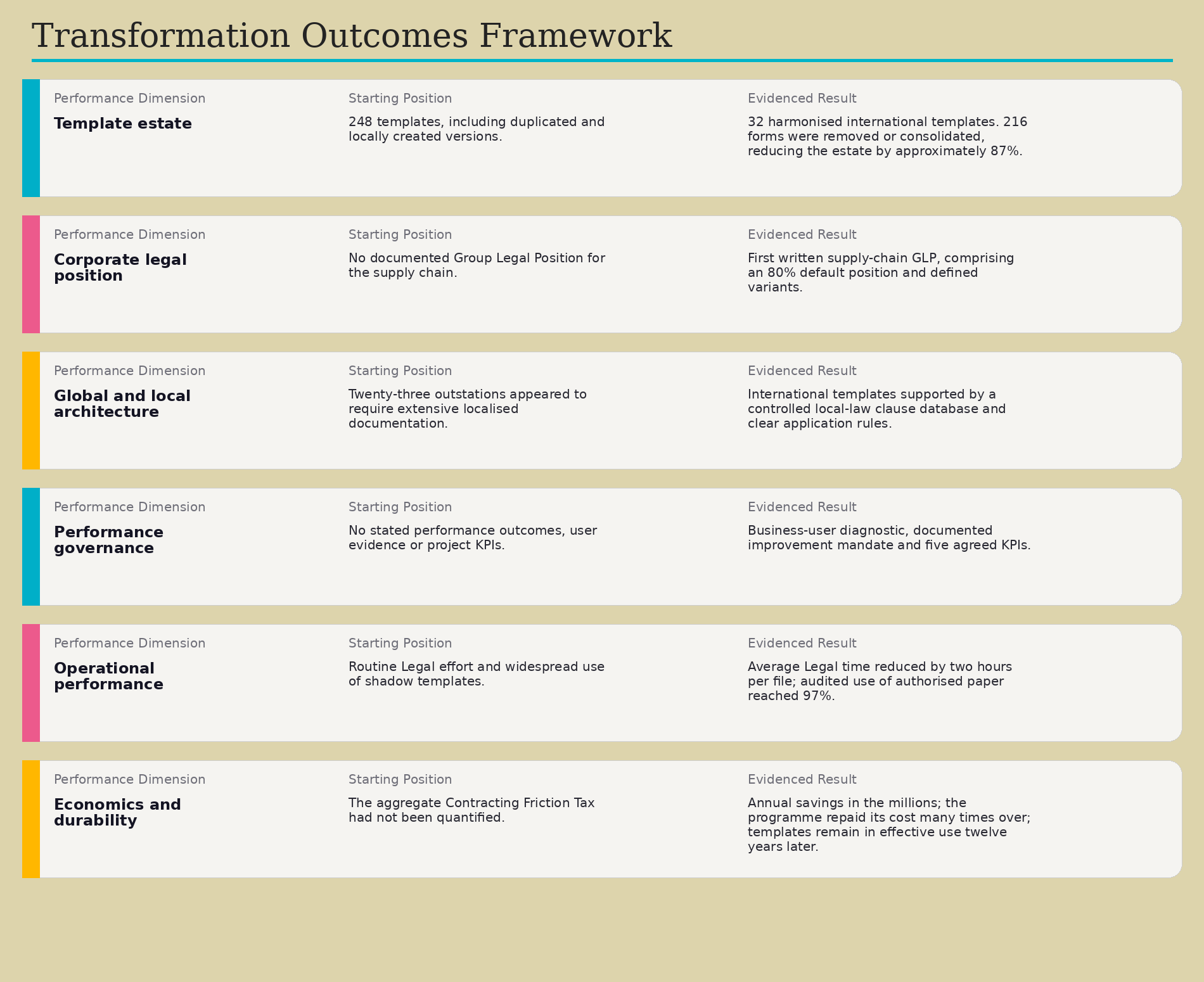
The programme was measured against the five agreed KPIs and produced evidenced contracting-performance improvement. Its annual savings ran into the millions, and those recurring savings repaid the original investment many times over. More than twelve years later, the resulting templates and supporting architecture remain in effective use.
The airline therefore received considerably more than a tidier library. It obtained a defined corporate legal position, a rationalised global architecture and an operating system of templates, clauses, playbooks, checklists, rules and training that worked together. The templates were the foundation; the surrounding decisions and tools allowed their performance to be realised.
That distinction also explains the economics. A multi-jurisdictional drafting exercise prices the production and review of a large volume of legal documents. Performance engineering first removes unnecessary templates, variants, negotiations and localisation work, then confines drafting to the architecture that remains. The project costs less because it avoids unnecessary production, while the resulting design creates value each time the templates are used.
The sequence is important. The work began with desired outcomes and user evidence, identified the causes of friction, established corporate legal policy, engineered the common drafting base, qualified each remaining asset and then standardised the tools required to use it. Drafting remained essential, but it followed the decisions that made the drafting valuable.
The following sections set out that approach in practical terms: the outcomes organisations can ask their templates to deliver, the measures needed to assess progress and the design requirements that make those outcomes achievable.
Performance attributes: what the template environment must deliver
The following framework identifies the outcomes that well-designed templates and supporting infrastructure can help achieve. Our objective here is to offer you a broader universe of thought about what your template project update can achieve.
Please note, the KPIs are candidate measures, not universal targets. Organisations should select those relevant to each transaction population, establish a baseline and define the improvement required.
A. Transaction efficiency and business enablement
Performance attribute | Description | Intended business outcome | Performance KPIs |
1. Faster, more predictable contract closure | Routine transactions move through preparation, negotiation and approval with fewer avoidable interruptions. The Business can anticipate when an ordinary contract or renewal will complete. | Earlier readiness to trade, mobilise suppliers or commence projects; timely renewals that preserve continuity and commercial options. | Contract closure time compression; contract renewal time reduction; percentage of new contracts and renewals completed within agreed timeframes. Measure reductions against comparable baseline populations. |
2. Less unnecessary negotiation | Appropriate opening positions and defined transaction pathways reduce the number of contracts requiring negotiation. Recurring issues have approved responses. | More suitable transactions conclude on standard terms; negotiation effort concentrates on matters capable of changing the commercial or risk outcome. | Non-negotiated completion rate; first-pass acceptance rate; negotiation rounds; proportion of clauses substantively amended; recurring objection frequency. |
3. Reduced routine Legal dependency | Eligible transactions proceed within approved parameters without matter-specific Legal intervention. Exceptions reach Legal because judgment is required. | Legal capacity is released for complex, material and strategic work while routine activity remains controlled. | Percentage of eligible transactions completed without Legal intervention; Legal hours per transaction; avoidable referral rate; mandatory escalation compliance. |
4. Competent front-line decision-making | Business users select the correct route, complete commercial inputs, apply approved fallbacks and recognise the limits of their authority. | More decisions are made correctly where business is conducted, with less rework and fewer inappropriate commitments. | Correct first-time template selection; completion accuracy; scenario-assessment results; appropriate escalation rate; unauthorised departure rate. |
5. Lower total cost to contract | Repeated work is removed across Legal, commercial teams, procurement, approvers and administrators, rather than transferred between functions. | Lower enterprise effort and external spend for comparable transactions. | Total transaction cost by pathway; Legal and Business hours per transaction; external spend per transaction; approval touches; rework hours. |
6. Greater commercial agility | The organisation can act quickly on opportunities involving customers, suppliers, projects or markets. Familiar transactions have immediately usable templates; genuinely new scenarios require limited, controlled adaptation. | Opportunities become revenue, supply capability or operational activity sooner, with fewer delayed or lost while suitable contracting arrangements are prepared. | Time from identified contracting need to readiness to transact; opportunities supported by existing templates or minor adaptations; opportunities delayed or lost through unavailable contracting arrangements; evidenced earlier revenue commencement or supplier mobilisation. |
7. Scalable contracting capacity | Increased transaction volumes can be absorbed without equivalent increases in staffing, effort or turnaround time. | More business is supported through the same resource base while service and control standards are maintained. | Comparable transactions per full-time-equivalent resource; hours per transaction; backlog age; service-standard attainment as volume increases; exception and error rates. |
B. Commercial value, risk and delivery
Performance attribute | Description | Intended business outcome | Performance KPIs |
8. Consistent, proportionate risk acceptance | Opening positions, permitted departures and approval thresholds reflect risk appetite and transaction significance. Accepted exceptions are visible and attributable. | Comparable transactions receive consistent treatment; material departures receive scrutiny; unnecessary conservatism does not obstruct routine business. | Unauthorised material deviation rate; approval compliance; completeness of exception records; recurrent policy departures. |
9. Better delivery of the commercial bargain | Contracts define workable deliverables, dependencies, acceptance criteria, responsibilities and responses to underperformance. | Improved delivery accountability and earlier intervention; fewer disagreements about what completion requires. | Milestones achieved on time; first-time acceptance of deliverables; failures linked to unclear requirements; time to resolve delivery exceptions. |
10. Stronger preservation and recovery of value | Pricing mechanisms, indexation, rebates, credits, warranties and other entitlements are usable. Negotiated concessions are visible before signature. | Less value is surrendered unintentionally during negotiation or lost through missed rights and weak administration. | Unapproved concession value; eligible entitlement value realised; missed adjustment or claim deadlines; substantiated leakage by cause; amounts recovered. |
11. Easier contract administration | Operational users can identify what must happen, by whom, when and with what evidence, without routinely seeking legal interpretation. | More reliable handover, lower administration effort and fewer missed obligations, notices or renewal decisions. | Handover completion time; material obligations with an owner and date; missed critical actions; administration hours; interpretation referrals. |
12. Fewer avoidable disputes | Ambiguous requirements, inconsistent documents and unclear change mechanisms are addressed before signature. Emerging disagreements have a workable resolution route. | Fewer disputes caused by preventable drafting or administration failures, and less disruption when disagreements arise. | Relevant disputes per comparable contract population; dispute-handling cost; time to resolution; recurrence of identified causes. |
13. Better counterparty experience | Agreements are understandable, commercially credible and straightforward to work with. Their presentation and operation reinforce professionalism. | Less resistance caused by the contracting experience; stronger confidence among customers, suppliers and business partners. | Ease-of-contracting feedback; clarification requests; objections to unnecessary complexity or disproportionate terms; documented contracting-related abandonment. |
C. Adoption, control and future capability
| Performance attribute | Description | Intended business outcome | Performance KPIs |
14. Greater user trust and adoption | Approved assets are accessible, current and easier to use than unofficial alternatives. Users can complete the intended task. | More transactions benefit from the approved design; shadow libraries and avoidable workarounds decline. | Current approved-template use across eligible transactions; obsolete or unofficial form use; task-completion success; abandonment and workaround rates. |
15. Sustainable global consistency | Common transactions use common architecture, with local differences introduced where justified and controlled. | Consistent corporate positions, fewer unnecessary variants and less duplicated review and maintenance. | Global-core adoption; uncontrolled local variants; local departures with a documented rationale and owner; duplicate review effort. |
16. Reliable automation and self-service | Suitable transactions are assembled and routed through defined inputs, rules and approvals, with exceptions directed appropriately. | Less manual handling and fewer assembly errors; wider automation without uncontrolled acceptance of unsuitable transactions. | Automated completion rate within the eligible population; manual correction rate; assembly defects; exception-routing accuracy; human touches per transaction. |
17. Usable contracting intelligence | Consistent terms, fields and decision records produce comparable information that reveals performance problems and commercial exposure. | Better visibility of obligations, deviations and negotiation patterns; more reliable analytics and AI-assisted activity. | Required-data completeness and accuracy; validated extraction accuracy by field; reporting preparation time; contracts with comparable structured records. |
18. Lower cost of change and sustained performance | Approved changes can be propagated across templates, guidance, translations and systems without recreating inconsistency. | The initial investment retains its value; changes in law, policy or business requirements are implemented more efficiently. | Time and effort to implement an approved change; affected assets updated within target; obsolete-version use; overdue reviews; recurring defects after updates. |
Templates contribute to these outcomes but do not independently control them. Delivery depends on counterparty capability and operational management. Cycle time depends on approvals and responsiveness. Adoption depends on accessibility, training and incentives.
The performance brief must identify those dependencies and assign responsibility for the surrounding changes.
See Part 2: Global Template Optimisation (Part 2)

The GLS Legal Operations Centre
Register to access your complimentary Day 1 Resource Stack packed with legal team performance resources.

GLS Ultimate Guide To Legal Operations
Download this and read it thoroughly and regularly. It is a wonderful transformation companion.

Book A No-Obligation Consultation
If you would like discuss your legal transformation needs, please book a 30 minute free consultation with us.
GLS Legal Transformation Boot Camp
Our hugely successful, 10-week long, email-based boot camp on how to effectively transform your legal team.