Back
Global Template Rationalisation & Optimisation: The Business Case for Contracting Performance Infrastructure (Part 1)
5 minutes • 23 Sep 23

Executive Investment Case
Every contract creates both a cost of contracting and an opportunity to protect, accelerate or lose commercial value. The quality of the infrastructure supporting that transaction has a direct bearing on each outcome.
Most multinational organisations nevertheless continue to treat contract templates principally as legal documents. Templates are commissioned by Legal, assessed by lawyers and regarded as complete when the drafting is legally acceptable.
That approach reflects the historic role of a template, but it materially understates the role that templates now perform across a modern enterprise.
A template influences how quickly a transaction can commence, how much professional time it consumes, which risks the organisation accepts, which commercial rights survive negotiation and whether those rights can be administered after signature.
It also determines how far routine activity can be delegated, how consistently decisions are made, and whether contract data can support workflow, automation, analytics and artificial intelligence.
Contract templates are therefore part of the organisation's operating infrastructure. When that infrastructure is fragmented, inconsistent or poorly designed, the organisation pays for the deficiency on every affected transaction.
The cost appears through Legal time, Business time, repeated negotiation, additional approvals, delayed revenue, external counsel, avoidable concessions, missed entitlements, disputes and administration. Because those costs sit across several functions and budgets, their aggregate effect is rarely visible.
Global template rationalisation and optimization converts that recurring and dispersed cost into a finite investment in a reusable enterprise capability. Properly engineered templates can produce seven classes of return:
◼️direct financial return through stronger value protection and reduced contractual leakage;
◼️lower transaction cost across Legal, the Business, procurement and contract administration;
◼️faster access to customers, suppliers, projects, markets and revenue;
◼️greater enterprise capacity without equivalent growth in headcount;
◼️more consistent and transparent risk control;
◼️improved contract performance after signature; and
◼️the standardised foundation required for self-service, CLMS, automation, analytics and AI.
Many of these returns arise every time the improved asset is used. Others increase as adoption grows and standardised data supports further automation. The resulting economics differ fundamentally from advisory expenditure consumed by a single matter.
The relevant investment question is therefore not whether the organisation will pay for contracting. It already does. The question is whether it will continue paying repeatedly for avoidable friction, or make a controlled investment that reduces that cost across future transactions.
RECOMMENDED ACTION:
The organisation should approve a measured programme to rationalise and performance-engineer its priority contracting assets. Approval should be framed as an enterprise performance investment, supported by the functions that receive the benefit, rather than as discretionary expenditure by Legal on document improvement.
The first phase should target contract types with sufficient volume, cost or value exposure to establish a clear return. Where that phase produces measurable savings and capacity, those benefits can support the business case and funding for subsequent phases.
The Misunderstood Asset
The traditional role of a template was to record the legal terms of an agreed bargain. Its contribution was assessed primarily by whether it created an enforceable contract and protected the organisation against identified legal risk.
That function remains essential, but it is no longer sufficient. A modern template also shapes how the bargain is proposed, negotiated, approved, signed, performed, administered, renewed, analysed and, when necessary, enforced. It may guide hundreds or thousands of transactions across several business units, jurisdictions, languages and delivery models.
This expanded role changes the standard against which template quality should be assessed. A contract can be legally sound while remaining a poor-performing business asset. It may be commercially misaligned, unnecessarily difficult to negotiate, inaccessible to intended users, expensive to administer, inconsistent with organisational risk appetite or incapable of supporting automation. It may protect valuable rights in theory while making them difficult to identify or exercise in practice.
The distinction matters because legal sufficiency is an input to performance, rather than a complete measure of it. A template that reliably produces slow, expensive or heavily escalated transactions has not performed well merely because its clauses are enforceable. Nor has a template performed well if the Business avoids it, counterparties routinely reject it, or administrators cannot operate the bargain it records.
Modern templates must be designed for a defined group of users and against a defined set of outcomes. Those users include Legal, commercial teams, procurement, finance, operational owners, counterparties, contract administrators and technology systems. Their needs are related, but they are not identical. Effective design reconciles them through a deliberate performance specification.
This is unremarkable in other forms of enterprise infrastructure. An organisation would not deploy software without identifying its users, functional requirements, controls, integration needs, data architecture and expected outcomes. One of the organisation's most frequently used commercial assets should not be designed to a lower standard.
The correct unit of analysis is also wider than an individual document. A services agreement, supply agreement, purchase order, statement of work, NDA and contract playbook should operate as connected components of one contracting environment. Common definitions, risk positions, approval logic, clause structures and data conventions allow that environment to be maintained, measured and improved as a system.
For that reason, template rationalisation should not be understood as document housekeeping. It is the design of contracting performance infrastructure.
The Contracting Friction Tax
Few organisations deliberately create a fragmented template estate. The problem usually develops through a sequence of individually reasonable decisions. A local market adjusts a clause, a lawyer improves a familiar form, a business unit keeps a version that worked on an urgent transaction, or an historic precedent remains available because ownership is unclear. Over time, exceptions accumulate and the relationship between the official library and the documents used in practice weakens.
The resulting symptoms are familiar:
◼️multiple versions of substantially the same agreement remain in circulation;
◼️local variants exist without a clear legal or commercial reason;
◼️different templates apply different positions to the same risk;
◼️drafting preferences become embedded as apparent enterprise requirements;
◼️historic forms survive because no owner is authorised to retire them;
◼️commercial teams maintain local copies or unofficial precedents;
◼️the same negotiation issues are researched and resolved repeatedly;
◼️business users cannot identify the correct document or approved fallback position;
◼️templates require routine Legal involvement that better design could remove;
◼️post-signature obligations and entitlements are difficult to identify or administer;
◼️template architecture does not reflect the organisation's approved risk appetite;
◼️document structure obstructs translation, digitisation or data extraction; and
◼️ownership, version control, review cycles and distribution are incomplete.
These conditions create a recurring Contracting Friction Tax. The term describes the enterprise cost caused by unnecessary complexity, duplication, delay, escalation, negotiation, inconsistency and lost contractual value within the contracting process.
The tax does not appear as a single item in the Legal budget. It is distributed across lawyer time, business time, procurement effort, management approvals, external counsel, delayed mobilisation, deferred revenue, contractual concessions, missed entitlements, disputes and manual administration. This distribution helps explain why a material cost can persist without receiving a corresponding investment response.
The cost is also repeated. A deficient template does not create friction once. It creates friction each time the organisation uses it, each time a counterparty challenges a predictable issue, and each time a user seeks approval because the template and its supporting tools do not provide a usable answer.
Organisations operating a basic contracting KPI regime can calculate a substantial proportion of this cost. Relevant measures include transaction volumes, Legal and Business hours, negotiation rates, cycle times, approval volumes, external spend, deviation rates, entitlement recovery and dispute incidence. Where those data are not presently available, a proportionate measurement regime can usually establish a reliable baseline without delaying improvement.
Do these symptoms apply to your contracting assets? If they do, the consequences extend beyond Legal efficiency. They are restricting the Business and imposing a recurring Contracting Friction Tax. GLS routinely assists organisations to identify, quantify and reduce that tax through contracting diagnostics and performance measurement.
The Performance Specification for a Modern Enterprise Template
A template should be engineered against an agreed enterprise performance specification.
The process should not end when the drafting satisfies the lawyer responsible for it, because the intended performance extends well beyond legal wording.
The following ten dimensions consolidate the legal, commercial, operational, user, global and technology requirements that a modern template environment should satisfy.
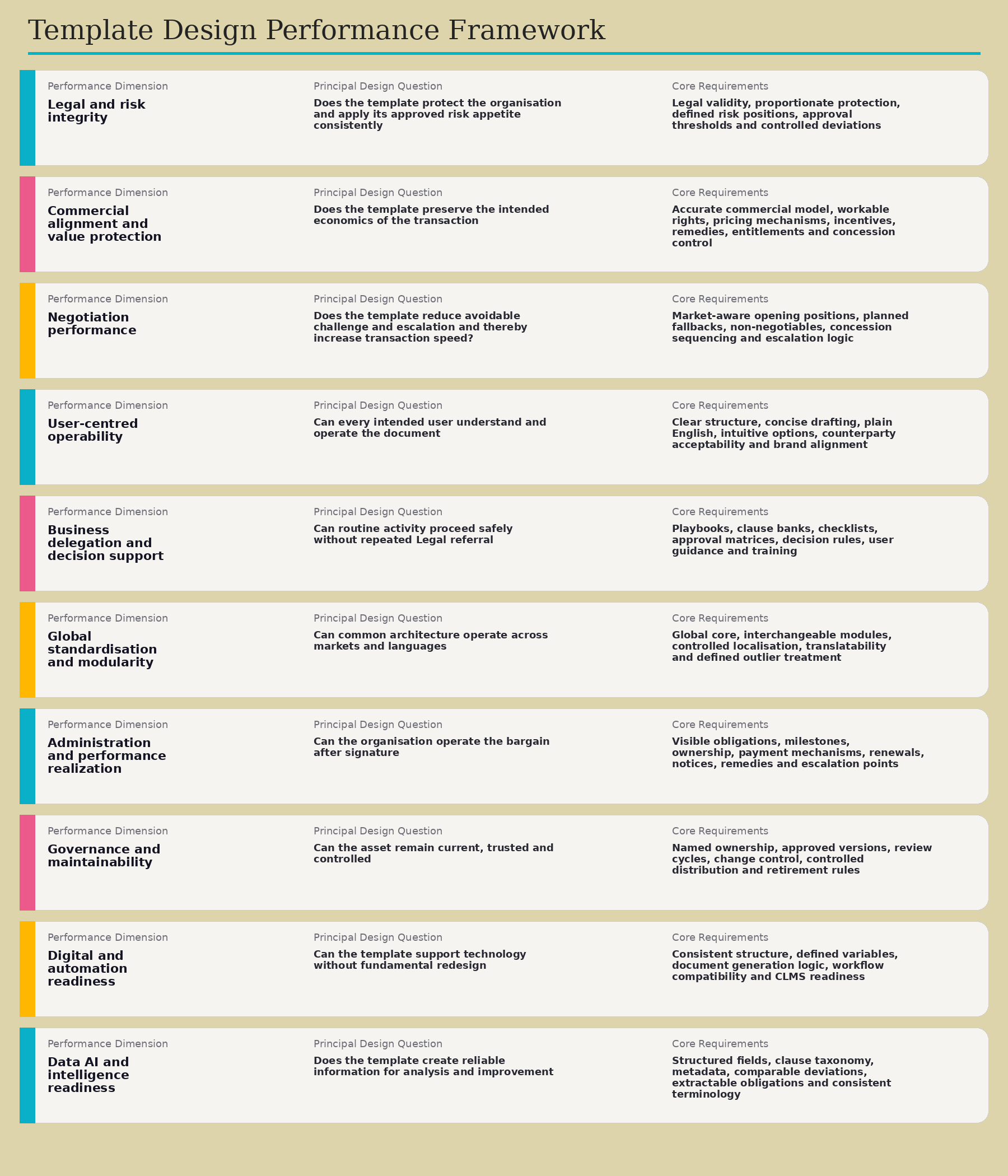
Legal risk and integrity
The template must remain legally effective and protect the organisation against the risks relevant to the transaction. The appropriate objective is not maximum theoretical protection in every clause. It is protection calibrated to the transaction, counterparty, market, bargaining position and approved enterprise risk appetite.
Risk appetite should be expressed through the template, its fallbacks and its approval architecture. Otherwise, different lawyers may produce individually defensible agreements that collectively expose the organisation to inconsistent risk. A well-designed environment makes the permitted position, the acceptable deviation and the required escalation clear.
Commercial alignment and value protection
The template must reflect the commercial model the Business intends to operate. Pricing mechanisms, service levels, credits, rebates, warranties, volume commitments, indexation, renewal rights and termination consequences should work together and remain usable after signature.
Commercial protection also requires control over value surrendered during negotiation. Opening positions, target positions, acceptable fallbacks and non-negotiables should be deliberately selected. Without that architecture, concessions can reflect individual negotiating style rather than transaction economics or enterprise policy.
Negotiation performance
A highly protective template can still perform poorly if every counterparty redlines most of it. Drafting should anticipate the issues that counterparties actually challenge, distinguish genuine protection from inherited preference, and establish fallbacks that permit routine negotiations to progress without repeated Legal escalation.
The objective is optimum risk-adjusted protection at the commercial speed required by the organisation. Negotiation performance can be measured through negotiation rates, redline volume, negotiation rounds, first-pass acceptance, escalation rates and Legal hours per transaction.
User-centred operability
Templates must work for everyone who uses them, including Legal, the Business, counterparties and those responsible for administration. They should be clear, concise, commercially intuitive and drafted in plain English wherever legal precision permits.
Structure matters as much as language. Users should be able to locate the operative term, understand available choices and identify the consequence of a decision without reconstructing the document's logic. A template should also present the organisation as sophisticated, reasonable and straightforward to work with. Counterparty experience affects both negotiation efficiency and corporate reputation.
Business delegation and decision support
The template should form part of a decision system. Commercial teams need to know what they may accept, what they may negotiate, what they must reject and when Legal or another approver becomes necessary.
That capability generally requires supporting playbooks, clause banks, checklists, FAQs, guidance, training and approval matrices. These assets should follow the same clause architecture and terminology as the template. When the components align, routine work can move closer to the people conducting the business without weakening control.
Global standardisation and modularity
Business-as-usual contracting should operate from a common architecture, with local deviations limited to those genuinely required by law, regulation or established commercial practice. Separate templates should be reserved for jurisdictions or scenarios that cannot sensibly operate within the common model.
Modular clauses and schedules allow local legal requirements, transaction options and business models to be added or removed without damaging document integrity. Drafting intended for multi-jurisdictional use should also minimise idiom, unnecessary linguistic complexity and concepts that translate poorly. Consistent terminology and clause order improve the accuracy and cost of translation.
Administration and performance realisation
A contract has limited value if the organisation cannot administer the bargain it secured. Obligations, deliverables, milestones, ownership, pricing adjustments, notices, renewals, warranties, credits and remedies should be easy to identify and operate.
This requirement connects pre-signature drafting with post-signature performance. The template should help operational owners understand what must happen, when it must happen, who is responsible and what follows if performance fails. Designing for administration reduces ambiguity, supports accountability and improves the prospect that negotiated value becomes realised value.
Governance and maintainability
A strong template deteriorates quickly without ownership and control. Each asset should have an identifiable owner, approved version, effective date, review cycle, distribution method and retirement process. Changes should be traceable and implemented consistently across related documents and support tools.
Modular and systematic structure reduces the cost of responding to legal, regulatory or commercial change. It also protects the initial investment by preventing the estate from returning to uncontrolled variation.
Digital and automation readiness
Templates should support electronic storage, search, document generation, workflow, approval routing, obligation management, reporting and CLMS deployment. Variables, optional clauses and decision points should be defined in a form that technology can use.
Automation readiness does not require immediate technology implementation. It ensures that future implementation does not require the organisation to redesign the underlying documents before the system can produce value.
Data AI and intelligence readiness
Contracts create enterprise data. Consistent fields, terminology, clause taxonomies, metadata and deviation categories allow that data to be extracted, compared and analysed across the portfolio.
The quality of future contracting intelligence will depend substantially on the quality and consistency of the information created today. AI can accelerate review and analysis, but it cannot reliably compensate for undefined terms, inconsistent clause structures, uncontrolled variants or incomplete metadata. Standardisation provides the stable reference point against which departures can be identified and interpreted.
Collectively, these dimensions create contracting architecture capable of supporting different jurisdictions, languages, technologies, transaction volumes and operating models. The precise specification should reflect the organisation's priorities, but none of the dimensions should be omitted without a conscious decision.
GLS maintains a broader Gold Standard specification covering the template, playbook, decision architecture, governance and supporting infrastructure required for optimal performance. Our design philosophy is intentionally restrained: the minimum infrastructure required to achieve the maximum sustainable outcome.
The Enterprise Return
The business case should be assessed through enterprise outcomes rather than benefits retained within Legal. Template rationalisation can generate return through seven connected channels.
Direct financial return
Contracts govern how value is created, protected and recovered. Better architecture can improve pricing enforcement, preserve negotiated protections, reduce unnecessary concessions and make rebates, service credits, indexation rights, claims, warranties, renewal economics and other entitlements easier to exercise.
World Commerce & Contracting reports average contract value erosion of 8.6 per cent across its broader research base.[1] Its more recent procurement-focused research reports average value leakage of 11 per cent, accumulated across missed savings, unmanaged clauses, unauthorised changes and other lifecycle failures.[2]
Those figures measure wider commercial and contract management performance. They should not be presented as the amount that template rationalisation alone will recover, or as a guaranteed return. They do, however, demonstrate the scale of value exposed through contracting. Recovering even a modest proportion of that exposure across a multinational contracting portfolio can materially exceed the cost of improving the underlying infrastructure.
A chief executive who recovered a meaningful portion of that value would not regard the result as a Legal efficiency. It would be recognised as a significant contribution to enterprise performance.
Lower transaction cost
The true cost of contracting includes lawyer time, business time, procurement effort, approvals, negotiation cycles, escalation, external counsel, administration and delay. Rationalisation reduces total cost by removing repeated analysis, aligning positions and enabling routine matters to proceed through an appropriate lower-touch pathway.
The savings should not be confined to a reduced Legal budget. Released internal time is an economic benefit even where it does not create an immediate cash reduction, because the same capacity can support additional transactions or more valuable work. A credible business case distinguishes cash savings from capacity value while recognising both.
Faster business and faster revenue
Contracting should enable the speed at which the Business can move. Shorter cycle times can support earlier customer signature, project commencement, supplier mobilisation, market entry, onboarding and revenue recognition. They can also reduce the number of commercial opportunities lost while contractual processes catch up.
Speed should not be pursued by weakening controls. A standardised environment increases speed by removing unnecessary variation, assigning decisions to the correct level and making required approvals predictable.
Greater enterprise capacity
Well-designed templates allow the Business to manage more routine activity within approved parameters and allow Legal to focus on matters that require legal judgment. Contract volumes can therefore increase without lawyer and business headcount rising in the same proportion.
The capacity effect extends across the enterprise. Commercial teams spend less time finding forms, interpreting provisions and relaying routine questions. Procurement can apply consistent positions. Legal can redirect effort towards material transactions, disputes, governance and strategic advice. Contract administrators can operate clearer obligations and entitlements.
Better risk control
Standardisation applies risk appetite consistently across business units, transaction types and markets. Defined departures become visible, approval thresholds become usable and the organisation can distinguish an authorised exception from uncontrolled variance.
This improves both control and transparency. It reduces reliance on unofficial forms, limits obsolete-document use and gives management a clearer view of where risk is accepted, by whom and for what reason.
Better contract performance
Clearer obligations, ownership, deliverables and consequences increase the likelihood that the commercial bargain is delivered. Ambiguity can be removed before it becomes a dispute, and operational teams can identify the rights and responsibilities that matter to performance.
The objective is broader than securing a strong position if a dispute arises. It is to reduce avoidable disputes, identify underperformance earlier and make the agreed remedies capable of practical use.
Technology automation and intelligence
Standardised templates provide the content and data architecture required for document generation, self-service, workflow, automated approvals, CLMS, portfolio analytics and AI-assisted review. Common clause structures and defined fields make both implementation and ongoing maintenance more manageable.
Technology cannot create coherent contracting policy from inconsistent source material. Where the underlying estate contains competing positions, undefined exceptions and uncontrolled variants, digitisation often transfers those problems into a more expensive environment. Rationalisation protects the return on technology investment by addressing the content and decision architecture first.
The Financial Case
The financial case should make visible both the present cost of contracting and the value of the future-state capability. It should use the organisation's own transaction volumes and cost base wherever possible, rather than relying on a generic industry multiple.
Two economic models are required because improving the efficiency of negotiated contracts captures only part of the opportunity.
Model One Making Negotiated Contracts Cheaper
For each contract type, the organisation can compare present and future transaction cost using the following structure:
Present transaction cost
Legal hours multiplied by Legal cost, plus Business and procurement hours multiplied by their respective costs, plus external counsel, approvals, administration and an appropriately evidenced cost of delay.
Future transaction cost
The same calculation after rationalisation, supported by measured or reasonably estimated reductions in effort, negotiation and cycle time.
The following illustration on the time it takes to support a template deliberately excludes external counsel, delay cost, disputes and value leakage. It demonstrates the scale available from internal time alone.
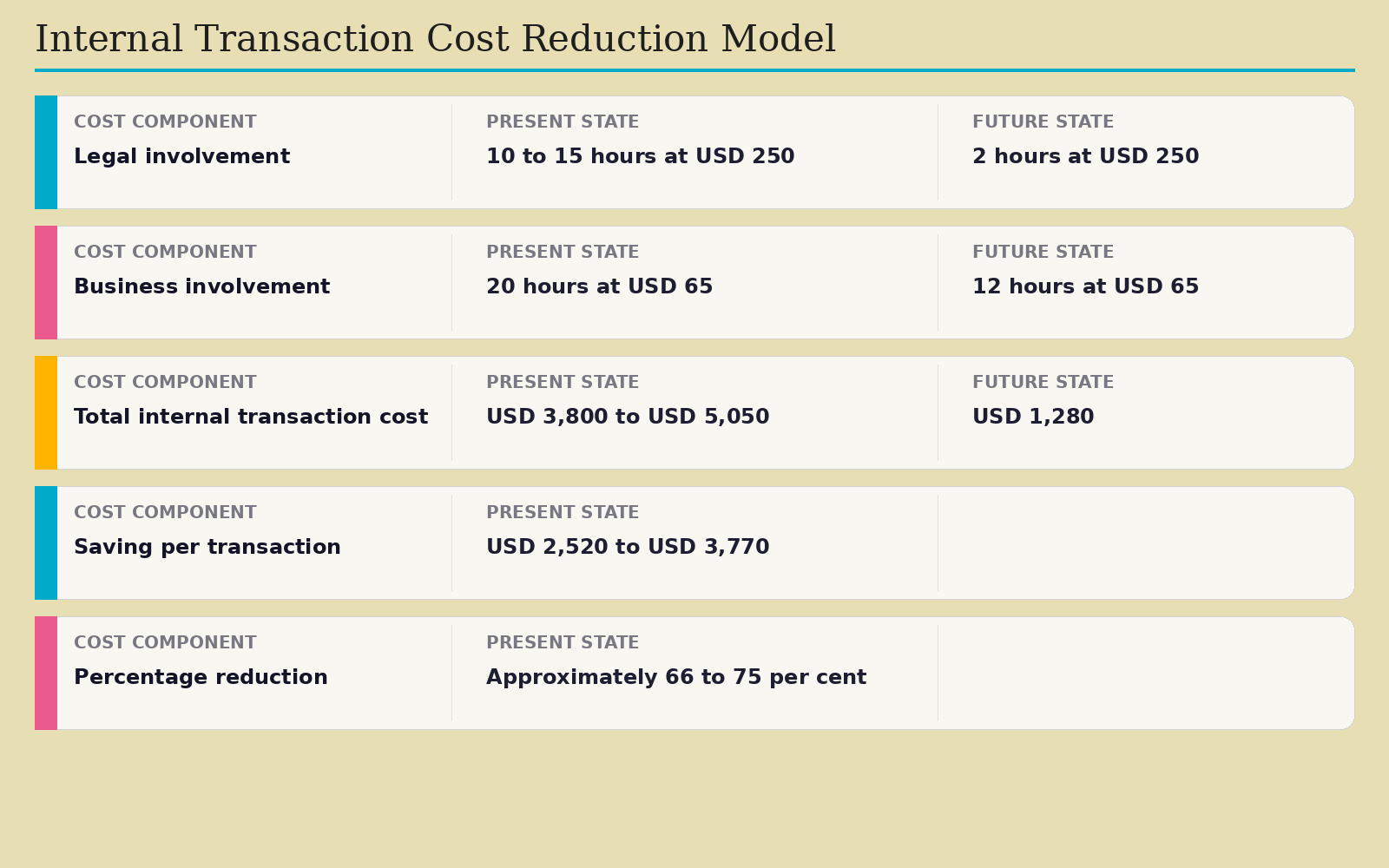
At 1,000 transactions each year, the illustrated capacity value is USD 2.52 million to USD 3.77 million. At 5,000 transactions, it becomes USD 12.6 million to USD 18.85 million. These figures are illustrative, but the calculation itself is straightforward and can be replaced with client data.
Model Two Removing Negotiation Where It Adds No Value
The cheapest negotiation is the one the organisation does not need to conduct. A mature business case should therefore ask which transactions genuinely require negotiation, rather than assuming that every current negotiation will continue in a more efficient form.
Contracting scenario analysis segments the inventory by transaction type, value, risk, leverage, deviation history, counterparty profile and commercial context. The organisation can then match each scenario to the correct template, approved position, decision process and level of human involvement.
This analysis should create three deliberate pathways:
◼️high-risk or strategically important transactions requiring expert negotiation;
◼️repeatable transactions capable of proceeding on approved terms without negotiation; and
◼️suitable transactions capable of progressing through a zero-touch or substantially automated process.
In one Middle East engagement, GLS redesigned the contracting architecture so that approximately 80 per cent of the relevant contracting inventory could proceed on a non-negotiated basis. The organisation generated savings measured in millions because the project did not merely reduce the cost of negotiation. It removed negotiation from the substantial majority of transactions within scope.
Non-negotiated contracting should not be confused with uncontrolled acceptance. It depends upon an appropriate scenario, a commercially acceptable template, defined authority and clear exception routing. Zero-touch contracting adds technology to that architecture, but the underlying standardisation must exist first.
Building the Organisation Specific Model
The business case can be constructed from a relatively small set of inputs.
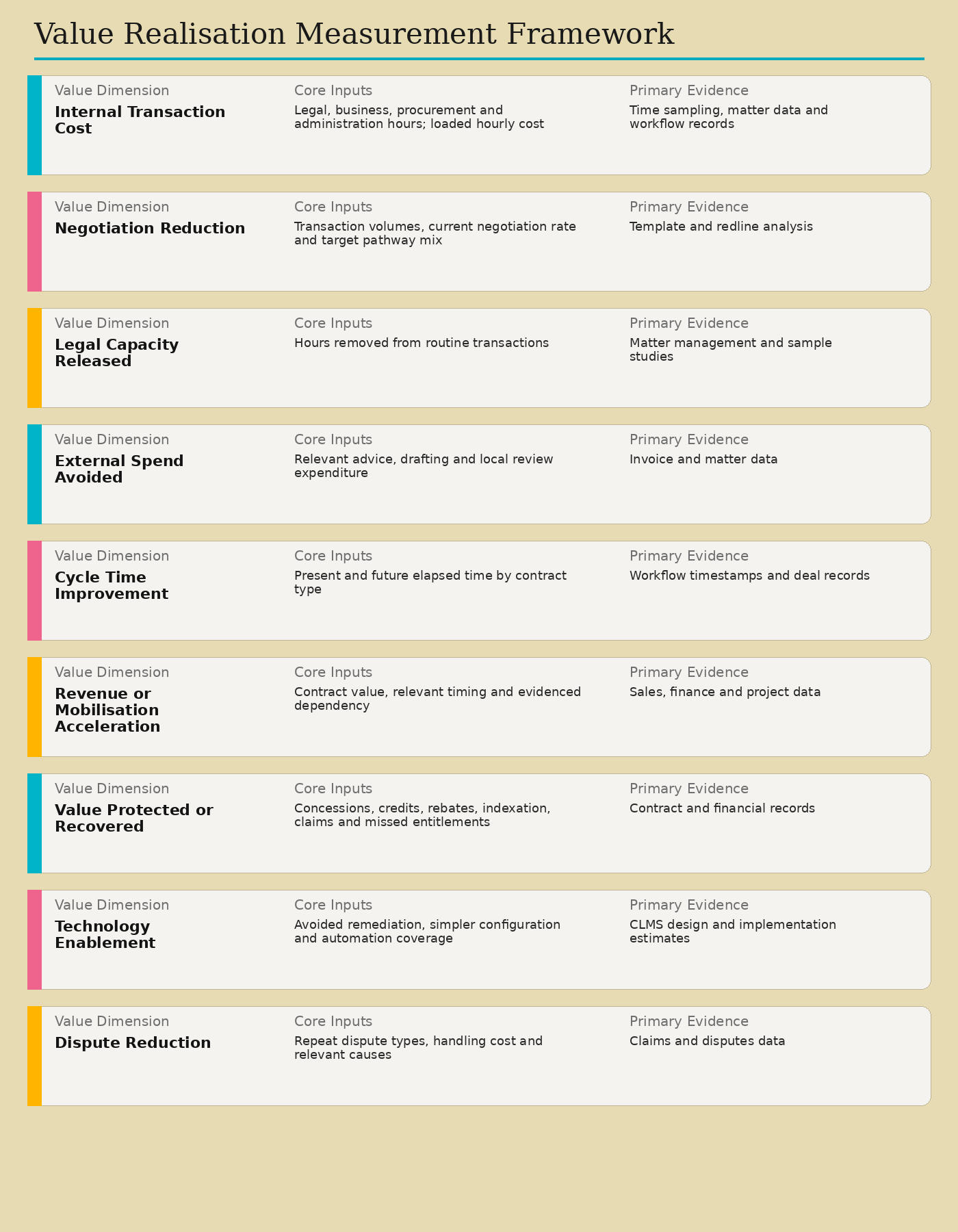
The model should avoid false precision. Delay value should be included only where the relationship between contracting time and financial outcome can be evidenced. Capacity released should be reported separately from cash removed from the cost base. Risk reduction should not be converted into a monetary value merely to enlarge the result.
Returns of 30 times project cost and above are entirely plausible where high-volume contract types move from repeated negotiation to approved non-negotiated pathways. The paper does not require the reader to accept that multiple as a generic promise. A stronger case uses the organisation's own volumes, costs and pathway opportunities to determine the anticipated return multiple.

The GLS Legal Operations Centre
Register to access your complimentary Day 1 Resource Stack packed with legal team performance resources.

GLS Ultimate Guide To Legal Operations
Download this and read it thoroughly and regularly. It is a wonderful transformation companion.

Book A No-Obligation Consultation
If you would like discuss your legal transformation needs, please book a 30 minute free consultation with us.

GLS Legal Transformation Boot Camp
Our hugely successful, 10-week long, email-based boot camp on how to effectively transform your legal team.