Back
Legal Department Operating Models: Centralised, Embedded & Hybrid
5 min • 24 Mar 26
Introduction: This Is Not a Theoretical Debate
Every in-house legal leader eventually faces the same deceptively simple question:
Where should legal sit to maximise leverage?
Not where does it report.
Not what does the org chart look like.
But where does legal physically, operationally, and culturally sit so that it:
◼️Delivers the right work
◼️At the right speed
◼️With the right level of control
◼️At the right cost
This is not an ideological debate.
It is a functional one.
And yet, most legal departments stumble into an operating model by accident:
◼️Copied from a prior employer
◼️Imposed by a CFO or COO
◼️Driven by headcount growth
◼️Or worse -never consciously designed at all
The result is depressingly predictable:
◼️Confused stakeholders
◼️Duplicated effort
◼️Shadow legal teams
◼️Inconsistent risk outcomes
◼️Burnt-out lawyers
This article sets out the three most recognised legal department operating models:
1. Centralised Legal Model
2. Embedded Legal Model
3. Hybrid Legal Model
For each, we examine:
◼️What the model actually is (not the marketing version)
◼️Why organisations choose it
◼️Where it genuinely works
◼️Where it predictably fails
◼️The hidden failure modes most leaders only discover too late
We then close with a proper decision-making framework -one that doesn’t just provoke thought, but actively pushes you toward a defensible choice.
There is no “best” model.
But there is a wrong model for your context.
The Three Core Legal Operating Models (At a Glance)
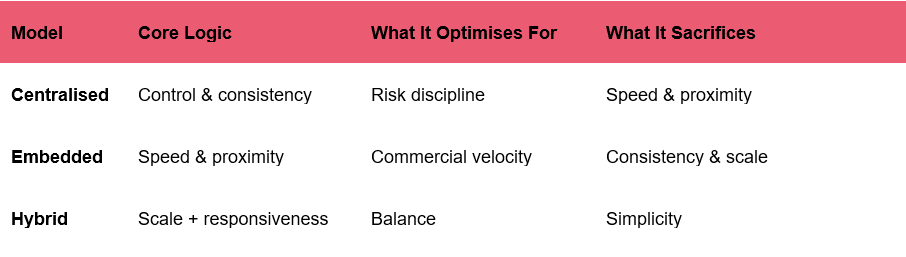
Bad design doesn’t come from choosing the “wrong” model.
It comes from mixing models without clarity.
That is how shadow legal teams are born.
Model 1: The Centralised Legal Department
What It Is
A centralised legal model places all (or nearly all) lawyers within a single legal function:
◼️One reporting line
◼️One leadership structure
◼️One intake and prioritisation mechanism
◼️One set of templates, playbooks, and standards
Business units consume legal services.
They do not own them.
Legal is positioned as a shared enterprise control function.
Why Organisations Choose It
Centralisation is attractive because it promises:
◼️Consistency
◼️Visibility
◼️Risk discipline
◼️Defensibility
It is the default model in:
◼️Highly regulated industries
◼️Public companies
◼️Early-stage in-house teams
◼️Organisations recovering from regulatory or litigation failure
In short: when the downside of inconsistency is severe, centralisation feels safe.
Where Centralisation Actually Works
Centralisation performs best when:
◼️The business model is relatively uniform
◼️Risk tolerance must be consistent enterprise-wide
◼️A large proportion of work is repeatable
◼️The legal team has strong process discipline
In these environments, centralisation creates real leverage.
The Real Advantages
1. Consistent Risk Posture: The organisation speaks with one legal voice. Precedent matters.
2. Compounding Knowledge: Templates, playbooks, and lessons accumulate instead of fragmenting.
3. Clear Accountability: When something goes wrong, ownership is unambiguous.
4. Measurability: Spend, workload, turnaround time, and risk exposure are visible.
5. Institutional Memory: Knowledge lives in the function, not in individuals.
The Structural Weaknesses
1. Speed Degrades: Everything flows through one pipe. Even good lawyers become bottlenecks.
2. Commercial Distance: Advice becomes technically correct but operationally frustrating.
3. Demand Inflation: When legal is “free”, demand explodes -often for low-value work.
4. Political Prioritisation: Without ruthless triage, the loudest stakeholder wins.
5. Innovation Suffers: Precedent slowly replaces judgment.
The Hidden Failure Mode: The Black-Hole Effect
Centralised teams often become black holes:
◼️Requests go in
◼️Time passes
◼️Outcomes emerge -eventually
Trust erodes.
And when trust erodes, the business routes around legal.
Model 2: The Embedded Legal Model
What It Is:
In an embedded legal model, lawyers sit directly within business units:
◼️They attend business meetings
◼️They sit with commercial teams
◼️They are judged on business outcomes
Legal becomes part of the delivery engine.
Why Organisations Choose It
Embedded models emerge when:
◼️Speed is existential
◼️The business is deal- or product-led
◼️Legal is expected to enable growth, not police it
Common in:
◼️Technology companies
◼️High-growth startups
◼️Sales-led organisations
◼️Transaction-heavy environments
Where Embedding Actually Works
Embedding works when:
◼️Lawyers are commercially strong
◼️Stakeholders can handle risk trade-offs
◼️The organisation tolerates variance
◼️Speed is a competitive weapon
The Real Advantages
1. Decision Speed: Legal advice happens in real time.
2. Commercial Fluency: Lawyers understand incentives, margins, and trade-offs.
3. Trust: Legal is seen as a partner, not a gatekeeper.
4. Upstream Risk Management: Issues are flagged before they crystallise.
The Structural Weaknesses
1. Fragmentation: Different units drift toward different legal standards.
2. Knowledge Leakage: Precedent lives in heads, not systems.
3. Business Capture: Lawyers optimise for approval rather than enterprise risk.
4. Duplication: The same problems are solved repeatedly in parallel.
5. Poor Scalability: Coordination costs explode as the organisation grows.
The Hidden Failure Mode: Shadow General Counsel
Business leaders treat “their” lawyer as their GC.
The result:
◼️Conflicting advice
◼️Inconsistent risk tolerance
◼️Broken escalation
Eventually, something breaks publicly.
Model 3: The Hybrid Legal Model
What It Is
The hybrid model deliberately blends:
◼️Centralised governance
◼️Embedded execution
Done properly:
◼️Risk posture is central
◼️Speed-critical work sits close to the business
◼️Knowledge is owned once, reused everywhere
This is the most common aspiration -and the most frequently botched. Why Organisations Choose It
Because it promises:
◼️Speed and consistency
◼️Proximity and control
◼️Scale and nuance
In theory, it is the best of both worlds.
In practice, it punishes sloppy design.
Where Hybrid Actually Works
Hybrid works when:
◼️Legal leadership is strong and respected
◼️Authority and escalation are explicit
◼️Knowledge infrastructure is real (not aspirational)
◼️Roles are unambiguous
The Real Advantages
1. Balanced Leverage: Resources are deployed where they create the most value.
2. Risk Discipline: Central oversight prevents silent drift.
3. Business Intimacy: Embedded lawyers stay close to operations.
4. Scalability: The model flexes with growth.
The Structural Weaknesses
1. Ambiguity: Who owns the decision? See our Blog - Why Hybrid Models Fail Without Authority.
2. Governance Drag: Too much process kills speed.
3. Cultural Friction: Central vs embedded becomes political.
4. Leadership Dependency: Weak leaders collapse this model fast.
The Hidden Failure Mode: Accidental Dual Reporting
Conflicting signals from legal and business leadership create paralysis.
If you are considering a Hybrid model - be ready to defend your choice before the Board. See What Boards Should Ask When Legal Says It Is “Hybrid”.
The Decision-Making Framework That Actually Works
This is the part most articles on legal department organisational design get wrong.
A real framework doesn’t just list factors.
It tells you what each factor pushes you toward - and why.
You are not choosing an org chart.
You are choosing which failure mode you are prepared to live with.
Below are 12 decision dimensions. Each one includes the “think about this → it might mean that” logic.
How to Use This
For each dimension:
1. Identify which description is most true in your organisation.
2. Note which model it pulls you toward.
3. Watch for deal-breakers (called out explicitly).
You will not get a perfect score.
You will get a clear direction.
The 12 dimensions that can actually help you decide your operating model
1) Regulatory & enforcement pressure
Think about: What happens if different parts of the business take different legal positions?
◼️If inconsistency creates regulatory exposure (licensing, privacy, AML, sanctions, safety) → Centralised / Hybrid
◼️If enforcement risk is mainly contractual/commercial → Embedded / Hybrid
It might mean that: if your worst day involves regulators (not customers), you need central control.
2) Cost of delay (deal velocity / product velocity)
Think about: Where does waiting destroy value?
◼️If legal delays kill deals, churn customers, or slip launches → Embedded
◼️If delay is painful but not value-destructive → Centralised / Hybrid
It might mean that: “speed” isn’t a preference -it’s a business requirement.
3) Work profile: volume vs judgement
Think about: Are you drowning in repeatable work or high-judgement work?
◼️High-volume, repeatable work (NDAs, low-risk sales, routine procurement) → Centralised + automation
◼️Low-volume, high-judgement work (strategic deals, novel risk, crisis) → Embedded / Hybrid
It might mean that: if most work is repeatable and you’re still doing bespoke drafting, your operating model is subsidising inefficiency.
4) Business geometry (single machine vs portfolio)
Think about: Is this one coherent business, or multiple mini-companies?
◼️One business model, shared processes, consistent contracting → Centralised
◼️Multiple units with different economics/risk profiles → Hybrid / Embedded
It might mean that: if you centralise a portfolio business, it will decentralise itself (informally) anyway.
5) Risk appetite variance
Think about: Do different units legitimately need different risk tolerances?
◼️Enterprise-wide “one voice” needed (brand, safety, data, bribery) → Centralised / Hybrid
◼️Genuine variance by market/product is unavoidable → Hybrid (guardrails essential)
It might mean that: embedded-only + high variance = inconsistent precedent + future incident.
6) Stakeholder maturity
Think about: Can business leaders actually make trade-offs?
◼️Low maturity (“just tell us what to do”, escalates everything) → Centralised
◼️High maturity (understands risk language, owns decisions) → Embedded / Hybrid
It might mean that: embedding lawyers into a low-maturity business creates dependency, not capability.
7) Need for standardisation as a strategic lever
Think about: Does the business win by being consistent?
◼️Standardised sales motion / scalable contracting / repeatable delivery → Centralised
◼️Differentiation + speed matters more than uniformity → Embedded / Hybrid
It might mean that: consistency isn’t “legal hygiene” -it’s margin.
8) Disputes, investigations & defensibility
Think about: How often do you need to defend past decisions?
◼️High dispute frequency / high consequence matters → Centralised / Hybrid
◼️Low dispute frequency, relationship-managed issues → Embedded viable
It might mean that: defensibility requires consistent records, positions, and escalation logic -that’s central governance.
9) Geographic spread / time zones / localisation needs
Think about: Does the business operate “24/7 across contexts”?
◼️Multi-region, fast execution, cultural/legal localisation critical → Hybrid / Embedded (with central standards)
◼️Single region, stable cadence → Centralised easier
It might mean that: a single central team becomes a choke point in global operations unless you design around it.
10) Talent reality (not the fantasy org chart)
Think about: What kind of lawyers do you actually have -and can recruit?
◼️Specialist-heavy bench, fewer true commercial athletes → Centralised
◼️Strong commercial generalists who can sit with the business → Embedded / Hybrid
It might mean that: embedded models don’t tolerate timid lawyers. They get captured or ignored.
11) Leadership authority (the Hybrid deal-breaker)
Think about: Can the GC/Head of Legal enforce standards across the enterprise?
◼️Strong mandate, CEO/board support, escalation works → Hybrid possible
◼️Legal gets bypassed, negotiated down, or ignored → Centralised (tight) or Embedded (explicitly + honestly)
Deal-breaker: weak leadership + Hybrid = ambiguity, politics, shadow legal.
12) Knowledge/process/tech infrastructure (the other Hybrid deal-breaker)
Think about: Can you build reusable assets and keep them alive?
◼️You have playbooks, templates, clause banks, triage, matter tracking → Hybrid / Embedded safer
You don’t → decentralisation amplifies chaos
Rule: If you can’t centralise knowledge, don’t decentralise people.
Scoring interpretation (direction, not false precision)
Mark each dimension as pulling C, E, or H.
Then apply these rules:
1. If you hit 2+ Hybrid deal-breakers (weak leadership + weak knowledge/process), don’t do Hybrid. You will fake it.
2. If C dominates by 4+, go Centralised -but invest hard in triage + self-serve + playbooks or you’ll become a bottleneck.
3. If E dominates by 4+, go Embedded -but hard-code enterprise non-negotiables + escalation or you’ll fragment.
4. If H “wins” by only 1–2, you likely don’t need Hybrid yet. You need clarity, not complexity.
“Must-haves” by model (so the choice actually works)
If you choose Centralised, you must have:
◼️ruthless triage (stop being the dumping ground)
◼️fast lanes for low-risk work
◼️templates/playbooks that people actually use
◼️self-service + automation for repeatables
If you choose Embedded, you must have:
◼️enterprise guardrails (data/privacy, bribery, safety, brand, sanctions etc.)
◼️precedent capture (otherwise you’ll drift)
◼️a real escalation path
◼️protection against business capture (lawyers need spine)
If you choose Hybrid, you must have:
◼️crystal role definitions (ownership)
◼️authority model (who can override whom)
◼️central ownership of knowledge + risk posture
◼️cadence: alignment forums, reviews, QA
Hybrid without those is just centralised confusion with embedded politics.
Final Thoughts: This Decision Will Expose You
This is the part most legal leaders underestimate.
Your operating model doesn’t just shape workflows.
It reveals what your organisation actually values.
◼️If you say speed matters, but centralise everything, you’re lying to yourself.
◼️If you say risk matters, but embed lawyers without guardrails, you’re gambling.
◼️If you say you want the best of both worlds, but won’t invest in leadership or infrastructure, you’re indulging in theatre.
There is no neutral choice here.
Every model amplifies something and sacrifices something:
◼️Centralised legal amplifies consistency - and exposes intolerance for delay.
◼️Embedded legal amplifies speed - and exposes discomfort with variance.
◼️Hybrid legal amplifies ambition - and exposes leadership weakness fast.
Most legal departments don’t fail loudly.
They fail quietly:
◼️Decisions slow down.
◼️Standards drift.
◼️Shadow legal teams emerge.
◼️Risk gets taken - just without visibility.
And by the time it’s visible, the model is already entrenched.
The real mistake is not choosing the “wrong” model.
The real mistake is not choosing at all -drifting into a structure that no one can explain, defend, or govern.
So be honest:
◼️About your risk tolerance.
◼️About your people.
◼️About your leadership authority.
◼️About what the business will actually tolerate when things go wrong.
Design for that reality.
Because structure is destiny in legal.
And this is one of the few decisions where pretending costs far more than being wrong.
Stop copying org charts. Stop debating ideology. Design the operating model your business deserves -and can actually sustain.
And remember, whatever model you go with - it will not work unless you officially secure the authority mandate for your legal team to fulfil its role. You will need a Legal Department Authority Mandate.
Ready To Transform Your Legal Team?
Please check out the GLS solutions and know-how resources listed on the right side of this page – they might assist your legal team with the issues explored in this Blog.
© The GLS Group - Law Rewritten

The GLS Legal Operations Centre
Register to access your complimentary Day 1 Resource Stack packed with legal team performance resources.

GLS Ultimate Guide To Legal Operations
Download this and read it thoroughly and regularly. It is a wonderful transformation companion.
Book A No-Obligation Consultation
If you would like discuss your legal transformation needs, please book a 30 minute free consultation with us.
GLS Legal Transformation Boot Camp
Our hugely successful, 10-week long, email-based boot camp on how to effectively transform your legal team.