Back
Managing Lawyers to Engineering Legal Performance - Why Traditional In-House Legal Models No Longer Scale
• 17 Jan 26
Introduction
For many years, in-house legal teams have been managed using human capital models that were never designed for scale, consistency, or measurable performance.
Those models evolved in a very different operating environment - one where legal work was slower, volumes were lower, and legal departments were expected to advise rather than operate.
Career development was informal, performance was inferred, and value was largely assumed.
That environment no longer exists.
Today, in-house legal teams are expected to operate as enterprise-grade functions - enabling growth, managing risk dynamically, integrating with technology, and demonstrating value to the business in clear, measurable terms.
Yet the way legal talent is planned, developed, assessed, and supported has remained largely unchanged.
The result is a growing mismatch between what in-house legal teams are expected to deliver and how legal human capital is actually designed.
Across the market, the signals are increasingly clear: elevated burnout, rising churn, inconsistent capability, stalled transformation, and persistent difficulty evidencing legal’s value. These are not isolated issues. They are symptoms of a structural problem.
This companion piece examines why traditional approaches to legal talent management no longer serve in-house lawyers - or the businesses they support.
It draws on observed practice and market evidence to show why the existing model is under strain, and why the next phase of legal operations requires a shift from managing lawyers to engineering legal performance.
The analysis also introduces the GLS Human Capital Line, part of the GLS Legal Operations Tube Map, as a practical framework designed to address these structural limitations and help legal teams build scalable, sustainable performance capability.
Core Characteristics of Traditional In-House Legal Team Member Management
(Observed realities - not criticism)
It is important to start with balance. In-house legal roles offer extraordinary opportunity today - arguably more so than at any other point in the history of the legal profession.
Proximity to decision-making, exposure to strategy, and the ability to shape outcomes at enterprise scale make the in-house environment uniquely powerful for many (but not all).
That opportunity, however, sits alongside structural characteristics that were never designed to function as a coherent performance system. What follows is not a critique of individuals or intent, but an examination of how the prevailing model operates in practice.
Career Planning Is Largely Individual-Led, Not System-Supported
In most in-house environments, career planning is an individual responsibility rather than an organisational discipline.
Very few in-house lawyers are actively supported to answer - let alone revisit - fundamental questions such as:
◼️ What career trajectory am I pursuing?
◼️ What capabilities do I need to build to get there?
◼️ How will progress be measured and recalibrated over time?
Large multinational organisations can be exceptions, but even there, progression is often titular rather than authority- or remuneration-driven. Titles may change, but decision rights, influence, and scope do not always move in parallel.
This creates a paradoxical environment: high opportunity, but low structural guidance.
Importantly, the opportunity side of that equation is real. The in-house lawyer who can demonstrably transform legal delivery and show measurable value to the business can access a radically different career trajectory.
That theme warrants separate treatment - and is a subject in its own right - but in the current state, that pathway is rarely systematised.
Promotion Pathways Are Opportunistic and Network-Driven
Promotion in in-house teams is typically triggered by openings, not progression frameworks.
Advancement commonly occurs when:
◼️ A role becomes vacant internally
◼️ A peer flags an opportunity elsewhere
◼️ A referral or informal introduction opens a door
These peer-led and network-driven moves are far more prevalent in-house than in private practice, where progression ladders are formalised and broadly understood.
This does not reflect favouritism - it reflects structural reality. In flatter organisations with fewer rungs, promotion is episodic rather than engineered. As a result, many capable lawyers operate without clarity on what comes next, what is being assessed, or how readiness is defined.
Performance Review Is Often HR-Led - by Design, Not by Fit
In larger organisations, in-house legal performance reviews are frequently HR-led.
HR plays a vital role in organisational health, but it is not - and cannot reasonably be expected to be - an institutional authority on legal judgment, legal risk calibration, or legal performance quality.
To put it politely: you would not ask a bus driver to assess the performance of a nuclear physicist - except perhaps to drive them to the appointment.
The result is that performance conversations often default to:
◼️ Behavioural proxies
◼️ Stakeholder sentiment
◼️ Generalised competency frameworks
rather than discipline-specific performance outcomes that genuinely reflect legal contribution.
Training Is Event-Based, Not System-Based
This is one of the most consequential characteristics.
Most in-house legal training is delivered through event-based mechanisms:
◼️ External courses
◼️ One-off workshops
◼️ Conference sessions
◼️ Vendor-led training
Much of the external legal training market is, frankly, sub-optimal - designed for scale and profitability rather than deep capability transfer.
This should be contrasted with internal business training, which is often excellent. Organisations invest heavily in onboarding lawyers into company culture, systems, and strategy - and rightly so.
However, when it comes to legal department capability, responsibility typically falls to the GC. That GC is almost always over-extended and under-resourced. Inevitably, development responsibility drifts to the individual lawyer.
The net effect is stark:
◼️ Most in-house lawyers are not receiving the training they need
◼️ Nor, critically, the training their cost base requires to justify its ROI
This is not a talent issue. It is a systems gap. And it directly caps the value multiple legal teams can deliver.
Performance Is Measured Subjectively Because Mandate Is Unclear
Performance subjectivity is not accidental - it is structural.
Most in-house legal teams operate without:
◼️ A formal legal department charter
◼️ A clearly articulated authority mandate
◼️ An agreed service-level compact with the business
Absent these foundations, performance cannot be measured objectively. There is no agreed reference point against which contribution can be assessed.
Compounding this, most legal teams:
◼️ Do not use legal operations metrics as a primary management tool
◼️ Do not translate work performed into recognised business KPIs
◼️ Do not consistently report value creation in terms the business values
In that context, subjective assessment is inevitable.
Capability Resides in Individuals, Not in Design
The cumulative effect of the above is that capability becomes person-dependent.
Knowledge, judgment, and performance live inside individuals rather than being embedded into:
◼️ Role design
◼️ Legal method
◼️ Decision frameworks
◼️ Scalable systems
When those individuals leave - which they frequently do - capability leaves with them.
Performance, however, is never purely individual. Systems are what allow individuals to perform at their best.
To use an analogy: you can hire the best rock climbers in the world - but ask them to scale a rock face without ropes, harnesses, chalk, shoes, or even clarity on which face they are climbing - and you will not see the value of their talent.
Human capital performance is enabled by design, not effort.
A Strong Self-Starter Imperative - with Structural Consequences
In-house legal roles require a high degree of self-starting capability:
◼️ Variable influence
◼️ Unwritten rules around risk and escalation
This autonomy attracts capable, pragmatic lawyers. But autonomy without structure amplifies variance. Some thrive; others plateau - not because of talent, but because performance expectations are implicit rather than engineered.
Authority and Status Vary Dramatically by Context
Unlike private practice, where hierarchy is globally consistent, in-house legal authority varies significantly by:
◼️ Country
◼️ Sector
◼️ Corporate maturity
◼️ Ownership structure
In government entities, civil service frameworks dominate progression.
In some regions - including parts of the Middle East - legal may sit beneath finance rather than alongside it as a functional peer.
Board access, influence, and decision rights can differ radically across otherwise similar roles.
These variations are driven less by law than by perception of legal’s value, which in turn is shaped by how legal performs.
Career Ambition Profiles Are Rational - but the Environment Is Shifting
Many in-house lawyers consciously choose not to pursue partnership-style career paths. For many, this is a rational, well-considered decision - not a lack of ambition.
Let’s be plain. Almost none of you reading this will be sitting on a front porch at 85, reminiscing about how “hard-charging” you were or how many weekends you sacrificed to projects that kept you away from your family. You will be thinking about your family - and wishing you had spent more time with them.
Perspective matters. Keep it real.
That said, if you choose to work, you should be good at it, be well rewarded for it, and ideally enjoy it - because that is what makes a career sustainable. The modern in-house model can offer all of this, and more. But that is a separate discussion.
Historically, in-house roles offered:
◼️ Stability
◼️ Sustainability
◼️ A degree of professional refuge from private practice intensity
That safe-harbour status is now under pressure. Attrition rates for in-house lawyers increasingly resemble private practice. Volume, pace, and complexity have all escalated.
The implication is not that in-house lawyers must work 70-hour weeks - but that they must work far smarter. That requires new skill sets, new systems, and a fundamentally different approach to performance design.
Evidence the Traditional Model Isn’t Working - Direct indicators and market signals
Taken together, the above characteristics describe a model that was never designed to operate as a performance system - yet is now expected to deliver enterprise-level value.
The argument for rethinking in-house human capital is not ideological. It is evidential.
If the traditional model of managing legal team members were fit for purpose in today’s environment, we would expect to see three outcomes at scale:
◼️ Sustainable performance
◼️ Stable retention
◼️ Compounding capability over time
Instead, the market is producing a consistent set of signals - some direct, some circumstantial - that point to a structural misalignment between expectations and design.
Here is the evidence that we point to support our contention that a new model for managing Legal Human Capital is very much needed.
Direct Evidence: Stress and Burnout Are Now Structural, Not Episodic
Stress among in-house counsel is no longer confined to isolated teams or high-pressure moments. It has become a persistent feature of the operating environment.
This matters because widespread stress is rarely explained by individual resilience or motivation. In management research, it is most often a signal that demand has outpaced the systems designed to absorb it.
In-house legal teams are expected to handle:
◼️ Rising work volumes
◼️ Greater complexity
◼️ Faster turnaround
◼️ Broader strategic engagement
Yet the underlying human capital model - how capability is developed, reinforced, and scaled - has not evolved at the same pace.
The result is predictable: effort substitutes for structure, and pressure accumulates.
Direct Evidence: Elevated Mobility and Churn Signals
Across the in-house market, job-search intent is high, and churn has become a defining feature rather than an exception.
Importantly, this is not limited to junior lawyers. Senior and mid-career counsel are also signalling dissatisfaction - often citing sustainability, lack of progression clarity, and insufficient development support.
These are leading indicators. They appear before formal attrition data catches up, and they are exactly how system strain manifests in professional services environments.
When experienced capability exits faster than it can be compounded, the system is no longer working as designed.
Direct Evidence: Exit Narratives Are Consistent, Not Random
When lawyers leave in-house roles, the reasons they give are remarkably consistent:
◼️ Unsustainable workload
◼️ Lack of structured development
◼️ Limited clarity on progression
◼️ Inability to deliver quality work predictably
These are not idiosyncratic complaints. They are systemic failure modes.
When the same reasons recur across organisations, sectors, and geographies, the conclusion is not that individuals are ill-suited - it is that the model itself is under-engineered.
Circumstantial Evidence: Weak Value Recognition Persists
Despite legal’s expanding remit, many organisations still struggle to articulate the value legal creates in business terms.
Legal performance is often inferred rather than measured. Contribution is assumed rather than demonstrated. As a result:
◼️ Legal remains framed as an expense to be managed
◼️ Investment in capability systems is constrained
◼️ Performance conversations default to volume and responsiveness
This creates a self-reinforcing loop: without metrics, value remains invisible; without visible value, the system is not upgraded.
Circumstantial Evidence: Development Infrastructure Is Thin by Design
Private practice - for all its intensity - has an embedded development engine:
◼️ Visible progression ladders
◼️ Dense peer benchmarking
◼️ Continuous exposure to “what good looks like”
Most in-house environments do not.
Progression is episodic, training is ad hoc, and development responsibility frequently falls to individuals or overstretched GCs. Capability does not compound institutionally - it resets with each departure.
This is not a failure of intent. It is a consequence of a model that was never rebuilt for scale.
Circumstantial Evidence: Capability Lives in People, Not Systems
In many legal teams, judgment, knowledge, and performance live inside individuals rather than being embedded into:
◼️ Role design
◼️ Authority frameworks
◼️ Scalable decision structures
When those individuals leave, capability leaves with them.
Performance, however, is never purely individual. It emerges when systems allow people to apply their expertise consistently, predictably, and at scale.
Without those systems, even excellent lawyers underperform relative to their potential.
Circumstantial Evidence: Authority and Expectations Are Misaligned
Legal authority varies dramatically by organisation, sector, and geography. In some contexts, legal operates as a strategic peer; in others, it is subordinate to finance or operations.
At the same time, expectations of legal leaders are rising. Boards and executives increasingly expect legal to:
◼️ Enable growth
◼️ Manage risk dynamically
◼️ Integrate with strategy and technology
When expectations rise faster than performance infrastructure, strain is inevitable.
Circumstantial Evidence: The Profession Has Changed - the Model Hasn’t
The demographic, motivational, and expectation profile of the legal profession has evolved.
Career aspirations are more diverse. Sustainability matters. Traditional “endurance models” are less acceptable.
Yet the operating model governing how in-house lawyers are developed and assessed remains largely unchanged.
Static systems in a dynamic profession produce predictable friction.
From Evidence to Architecture: Why a New Human Capital Model Is Required
The evidence outlined above does not point to a profession in decline. It points to a system that has been overtaken by its operating context.
In-house legal teams are more capable than ever. They are better trained, closer to the business, and entrusted with broader responsibility.
Expectations have risen - not fallen. The strain being felt across the market is not a signal that in-house lawyers are failing; it is a signal that the model governing how legal human capital is designed, developed, and deployed has not kept pace.
Traditional approaches to managing legal team members were never intended to function as performance systems. They emerged organically, borrowing lightly from HR frameworks and professional norms at a time when legal work was slower, volumes were lower, and judgment did not need to scale across global enterprises.
That environment no longer exists.
Today, legal teams are expected to:
◼️ Operate at enterprise scale
◼️ Deliver consistent judgment across complex risk profiles
◼️ Integrate seamlessly with business, technology, and data
◼️ Demonstrate value in measurable, business-relevant terms
Yet most in-house human capital models still rely on:
◼️ Individual effort over system design
◼️ Informal progression over engineered capability pathways
◼️ Episodic training over embedded performance reinforcement
◼️ Personal judgment over scalable legal method
The gap between what legal teams are expected to deliver and how their human capital is structured is now one of the primary constraints on performance.
Addressing that gap does not require lawyers to work longer hours, become more resilient, or accept greater pressure. It requires something far more fundamental: a deliberate shift from managing people to designing performance.
This is the premise behind the GLS Human Capital Line within the GLS Legal Operations Tube Map.
The Human Capital Line treats legal team members not as roles to be administered or costs to be controlled, but as performance infrastructure.
It is built on the proposition that sustainable, scalable legal performance only emerges when mandate and authority, capability, and measurement are deliberately designed - and reinforced as a system.
Rather than focusing on isolated initiatives, the GLS Human Capital Line provides a structured way to identify:
◼️ Where performance is being created
◼️ Where it is being constrained
◼️ Where design interventions will unlock disproportionate value
In other words, it moves the conversation away from why people are under pressure and toward how performance can be engineered so pressure is no longer the default.
Taken together, these signals point to a clear conclusion:
The traditional in-house human capital model was never designed as a performance system - and the market is now exposing that design gap.
The problem is not talent.
The problem is not effort.
The problem is architecture.
That is why the next phase of in-house legal maturity requires a shift from managing lawyers to engineering legal performance - the premise on which the GLS Human Capital Line is built.
Overview: The GLS Human Capital Line (Contextual Summary)
The GLS Human Capital Line is part of the GLS Legal Operations Tube Map and exists to address a specific and increasingly visible problem: traditional approaches to managing in-house legal team members were never designed to function as performance systems.
Rather than focusing on roles, titles, or isolated development initiatives, the GLS Human Capital Line treats human capital as performance infrastructure - and as such relies on 8 foundational dimension of performance engineering to determine the composition of the overall line in terms of Stations we have included to help legal teams utilise their human talent to operate at enterprise scale.
The Human Capital Line itself (i.e. the constellation of Stations) allows you to engage with your legal team human capital using familiar concepts and language, while the performance engineering occurs in the background as you optimise each Station in line with the Station-level guidance and its associated intelligence pieces.
For good order, the Human Capital Line is structured around eight Foundational Dimensions - which we believe are the core design areas that determine whether legal capability compounds or collapses into dependency on individual effort:
1. Mandate & Authority: Why legal exists, what it owns, and how authority is exercised - so performance is measured against something real, not vibes.
2. Legal Method: How legal judgement is formed, standardised, and relied upon - so advice and risk calls don’t vary wildly depending on “which lawyer you asked”.
3. Team Selection & Composition: How capability is assembled and deployed - full time, flexible, specialist, surge - as a deliberate design decision, not staffing drift.
4. Essential Operating Infrastructure: The base environment that makes lawyers effective (structures, procedures, legal ops coordination, foundational platforms) - without which performance becomes heroic and fragile.
5. Team Enablement: How judgement is converted into scalable output through leverage (process and procedures, knowledge, tools) - so the team stops doing high-cost, low-IQ repeat work.
6. Lawyer Development & Progression: How capability compounds over time - with visible pathways and progression logic that reduce attrition and lift quality.
7. Securing Team Performance: Making performance explicit (quality, consistency, alignment, effectiveness) - measured and reinforced, not assumed.
8. Continuity, Governance & Sustainability: The governance rhythm that keeps standards intact through growth, pressure, and churn - so the system survives people changes.
The Foundational Dimensions that underpin the GLS Human Capital Line are explained in detail in the GLS article Introducing the GLS Human Capital Line for In-House Legal Teams. Reading that piece allows you to see which stations are designed to deliver and drive each of the eight Foundational Dimensions.
From Diagnosis to Contrast
The comparison below is not intended to criticise legacy approaches. It is intended to make visible the structural differences between:
◼️ A model designed to manage lawyers
◼️ A model designed to engineer legal performance
It is at this point - where diagnosis gives way to contrast - that the implications of treating human capital as performance infrastructure become most clear.
Traditional In-House Legal Model vs GLS Performance-Based Human Capital System
The comparison below is intended to illustrate how different assumptions about human capital design produce different performance outcomes.
On one side is a traditional in-house model that evolved organically over time. On the other is a performance-based system designed to support consistency, scalability, and measurable value.
The table helps explain why many challenges experienced by in-house legal teams today - including sustainability, capability loss, and difficulty evidencing value - persist even when teams are well staffed and highly competent.
The takeaway is not that one approach is “right” and the other “wrong”, but that structure determines performance. How mandate and authority, development, and measurement are designed directly shapes what a legal team can realistically deliver.
This comparison highlights where design choices matter most.
| Dimension | Traditional In-House Legal Model | GLS Performance-Based Human Capital System |
| Primary Lens | HR management and role administration | Legal performance engineering |
| View of People | Cost centre to be managed | Core performance infrastructure |
| Career Planning | Individual-led, informal, inconsistent | System-supported, deliberate, regularly recalibrated |
| Progression Pathways | Opportunistic, vacancy-driven, network-led | Designed pathways tied to capability and authority |
| Titles vs Authority | Titles may change without meaningful authority shift | Authority, mandate, and accountability move together |
| Promotion Logic | Triggered by openings or referrals | Triggered by readiness and system need |
| Performance Assessment | Subjective, sentiment-based, HR-led | Role-specific, outcome-based, legally grounded |
| Performance Metrics | Limited or absent | Explicit, measurable, business-relevant KPIs |
| Training Model | Event-based, ad hoc, externally driven | System-based, embedded into role and legal method |
| Skill Development | Left largely to the individual | Designed, reinforced, and scaled by the system |
| Legal Judgment | Personal, inconsistent, person-dependent | Codified, repeatable, scalable |
| Knowledge Retention | Walks out the door with individuals | Embedded into design, tools, and method |
| Reliance on Individuals | High (key-person dependency) | Low (system enables individuals) |
| Self-Starter Requirement | Implicit and uneven | Supported by structure, clarity, and guardrails |
| Authority in the Business | Variable, perception-driven | Earned through consistent, visible performance |
| Integration with Tech & Process & Procedures | People, process and procedures, tech treated separately | Human capital designed to enable process and procedures and tech |
| Response to Churn | Capability loss | Capability retained and transferred |
| Value Narrative to the Business | Difficult to articulate | Explicit, measurable, credible |
| ROI on Legal Cost Base | Largely assumed | Actively engineered and demonstrated |
| Operating Mindset | “Good lawyers will figure it out” | “Performance must be designed” |
Conclusion: From Structural Constraint to Performance Advantage
The analysis above makes one thing clear.
The traditional in-house legal human capital model has not failed because lawyers lack capability, commitment, or ambition. It has failed because it was never designed to operate as a performance system - and is now being asked to carry expectations it was not built to support.
For years, in-house legal performance has relied on effort compensating for design gaps. Talented lawyers have worked harder, absorbed pressure, and improvised solutions inside structures that do not compound capability or retain value. That approach has reached its natural limit.
The evidence is now visible:
◼️ Performance strain is persistent
◼️ Retention is fragile
◼️ Capability is lost rather than compounded
◼️ Value remains difficult to evidence
At this point, continuing to optimise within the traditional model will not deliver materially different outcomes. The constraint is no longer execution - it is architecture.
The next phase of in-house legal maturity therefore requires a clear shift: from managing lawyers to engineering legal performance.
That shift does not demand longer hours, greater resilience, or more individual heroics. It demands something far more practical and far more powerful: deliberate performance design.
This is the role of the GLS Human Capital Line within the GLS Legal Operations Tube Map.
The Human Capital Line exists to help legal leaders see - clearly and systematically - where performance is being created, where it is being constrained, and where targeted design interventions will unlock disproportionate value. It treats human capital not as an HR concern, but as core operational infrastructure.
This companion piece has focused on why the traditional approach no longer serves in-house legal teams or the businesses they support. The GLS Human Capital Line is about what comes next.
For those who want to move beyond diagnosis and into performance architecture, the full Human Capital Line - and the system that brings it to life - is explored in detail elsewhere within the GLS Legal Operations Tube Map.
So, my final word on this topic ….
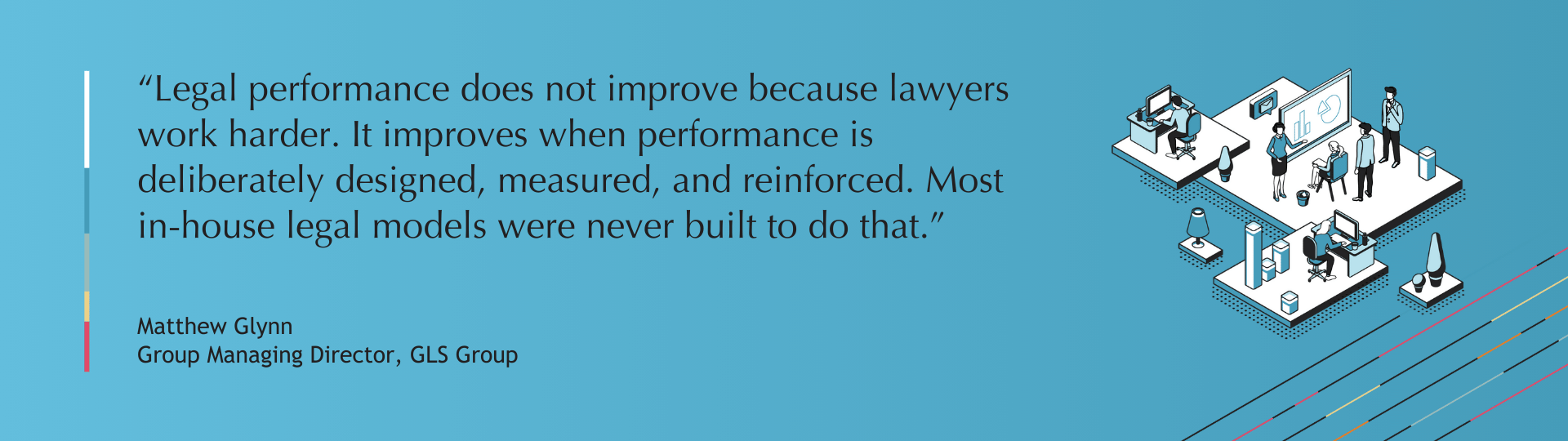
“In-house legal teams don’t underperform because lawyers aren’t good enough. They underperform because performance has never been deliberately designed. Once you treat human capital as infrastructure, not headcount, everything changes.”
- Matt Glynn
Ready To Transform Your Legal Team?
Please check out the GLS solutions and know-how resources listed on the right side of this page – they might assist your legal team with the issues explored in this Blog.
© The GLS Group - Law Rewritten
Tips & Observations:
◼️ Talent isn’t the constraint - system design is: Most in-house legal teams have capable lawyers. What they lack is a system that allows that capability to scale, repeat, and compound.
◼️ Career progression without architecture creates drift: When progression is informal and vacancy-driven, lawyers optimise for movement, not mastery - and capability fails to accumulate institutionally.
◼️ Event-based training is a poor substitute for legal method: Courses and workshops cannot replace codified legal approaches embedded into roles, workflows, and decision frameworks.
◼️ Subjective performance reviews are a structural outcome, not a flaw: Where mandate and authority, and service expectations are unclear, performance can only ever be inferred - never measured.
◼️ In-house churn is a systems signal, not an engagement problem: When experienced capability exits faster than it compounds, the operating model - not the people - is under-engineered.
◼️ Legal teams still manage people as costs, not as performance infrastructure: Until human capital is treated as a design problem, legal performance will remain fragile and person-dependent.
◼️ Scaling judgment matters more than hiring more lawyers: Without legal method, infrastructure, and performance feedback loops, headcount growth simply amplifies inconsistency.
◼️ The Human Capital Line works because it exposes the system beneath: The power of the Line is not navigation - it is making performance constraints visible and forcing the design decisions most teams avoid.

The GLS Legal Operations Centre
Register to access your complimentary Day 1 Resource Stack packed with legal team performance resources.

GLS Ultimate Guide To Legal Operations
Download this and read it thoroughly and regularly. It is a wonderful transformation companion.
Book A No-Obligation Consultation
If you would like discuss your legal transformation needs, please book a 30 minute free consultation with us.
GLS Legal Transformation Boot Camp
Our hugely successful, 10-week long, email-based boot camp on how to effectively transform your legal team.