Back
Time Recording: The Strategic Lens Your Legal Team Can’t Ignore
Counting hours without becoming a slave to the clock.
5 minutes • 22 Dec 25
Introduction: The Elephant in the Room
Let’s start with the uncomfortable truth: most in-house lawyers hate the idea of time recording. Many left private practice precisely to escape the tyranny of the billable hour. The thought of logging every six-minute increment feels like a regression - a return to a world they deliberately left behind.
But here’s the reality: that boat has sailed. Modern legal departments are under relentless pressure to demonstrate value, optimise resources, and speak the language of business - which is data. And data about how time is spent is the foundation for every conversation about efficiency, resourcing, and ROI.
Time recording for in-house teams does not mean becoming a slave to the clock. It means using time data as a strategic diagnostic tool - a keyhole through which you view workload patterns, cost drivers, and opportunities for improvement. Done right, it empowers legal leaders to make informed decisions about who should do the work, whether it’s being done at the right cost, and how to justify headcount or senior hires.
Why Time Recording is Essential (Even If You Hate It)
Here’s why time recording matters:
◼️Visibility: Without time data, you’re flying blind. You can’t know where the team’s effort goes, which tasks consume the most resources, or whether senior lawyers are bogged down in low-value work.
◼️Efficiency: Time analysis reveals bottlenecks, duplication, and opportunities for delegation or automation.
◼️Value Conversations: When the business asks, “What do we get for our legal spend?”, time data provides the answer.
◼️Cost Allocation: In shared services models, accurate time recording underpins fair recharging to business units.
◼️Performance Tracking: KPIs like “average time per matter” or “cost per contract” depend on time data.
PAA:
Is time recording the same as billable hours?
No. In-house time recording is about capturing effort for analysis, not billing clients.
The Strategic Case for Time Recording
Think of time recording as a diagnostic tool, not a compliance burden. It’s the equivalent of a health check for your legal function. Without it, you’re guessing at workload distribution and resource utilisation. With it, you can:
◼️Identify Workload Patterns: Which work types dominate your team’s time? Contracts? Compliance? Litigation?
◼️Optimise Resourcing: Are senior lawyers spending hours on tasks that could be delegated or automated?
◼️Justify Investment: Need another headcount or a senior hire? Time data provides evidence.
◼️Benchmark Performance: Track improvements over time - e.g., reduction in average time per matter.
Even rough estimates can be valuable. A quarterly snapshot of time allocation by work type can reveal trends and inform decisions. Of course, the more granular your data, the richer your insights - but perfection is not the goal. Progress is.
The Business Perspective: ROI and Accountability
Here’s the uncomfortable truth: lawyers are expensive. For the business to feel comfortable about the ROI on its legal spend, it needs visibility into what the legal team does and how much it costs. Time recording provides that visibility.
Without it, legal risks being perceived as a black box - a cost centre with opaque outputs. With it, legal becomes a data-driven business partner, able to demonstrate value and justify investment.
PAA:
Why do in-house legal teams need time recording?
To understand workload patterns, optimise resources, and justify headcount.
Shared Services and Recharging: The Emerging Reality
Increasingly, organisations are adopting shared services models for legal. Under these models, legal costs are recharged to business units based on usage. This is sensible — but it requires a basis for charging. That basis is time.
Without time data, cost allocation becomes arbitrary, leading to disputes and mistrust. With time data, recharging is transparent and defensible. It also creates incentives for business units to manage demand responsibly
KPIs and Performance Metrics: Speaking the Language of Business
Time recording unlocks KPIs that matter to the business, such as:
◼️Average Time Per Matter: Demonstrates efficiency gains over time.
◼️Cost Per Contract: Links legal effort to commercial outcomes.
◼️Resource Mix: Shows whether work is being done at the right level.
These metrics enable legal to speak the language of business - cost, efficiency, and value.
Addressing the Objections: “We Don’t Want to Be Slaves to the Clock”
This is the biggest objection. Here’s the answer: you don’t have to be. Time recording for in-house teams is not about six-minute increments or daily timesheets. It’s about periodic, structured capture - weekly, monthly, or quarterly snapshots that provide enough data for meaningful analysis without creating administrative burden.
Modern time recording tools make this easy. Many integrate with matter management systems, allowing lawyers to log time against matters with minimal effort. Some even use passive tracking to capture activity automatically.
Tools and Technology: Simple Solutions, Big Impact
There are plenty of simple, affordable time recording solutions on the market. Features to look for include:
◼️Ease of Use: Minimal friction for lawyers.
◼️Integration: Connectivity with matter management and reporting systems.
◼️Analytics: Dashboards that turn raw data into actionable insights.
◼️Flexibility: Support for periodic capture, not just daily timesheets.
PAA:
What technology supports time recording?
Cloud-based platforms with integration to matter management systems.
Pros and Cons: Let’s Be Honest
Time recording is not without challenges. The cons include:
◼️Cultural Resistance: Lawyers hate it.
◼️Administrative Burden: If implemented poorly, it creates friction.
◼️Data Quality Issues: Inaccurate or incomplete entries undermine insights.
But the pros outweigh the cons:
◼️Visibility: You know where time goes.
◼️Efficiency: You identify opportunities for improvement.
◼️Accountability: You justify cost and resource decisions.
◼️Strategic Insight: You speak the language of business.
The Bottom Line: Data is Non-Negotiable
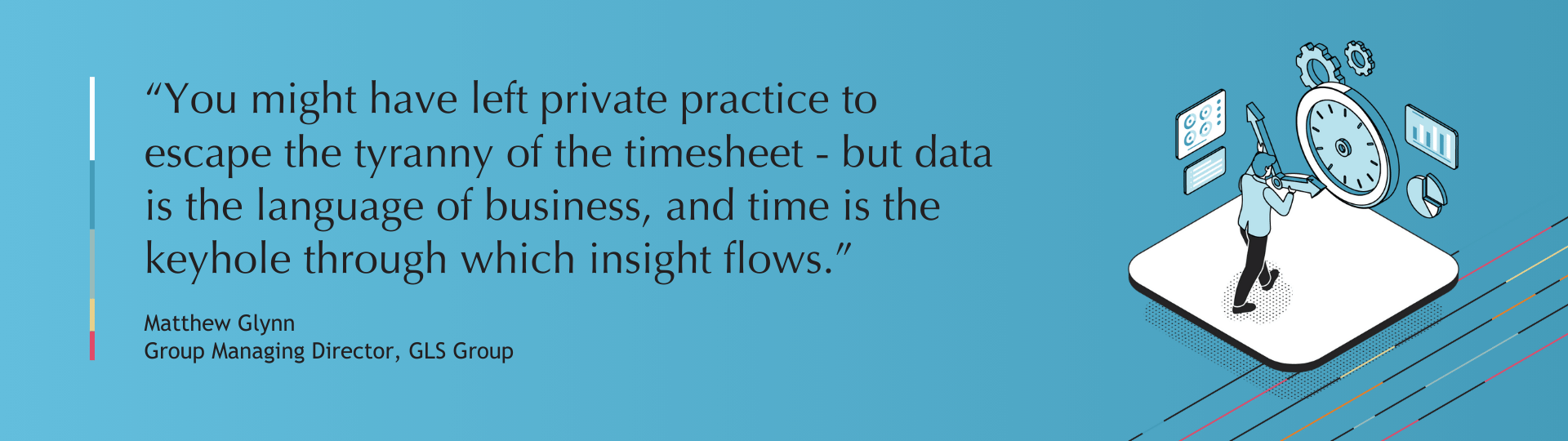
In-house lawyers may hate time recording. But here’s the reality: data is the language of business, and time is the keyhole through which insight flows. If legal wants to be seen as a strategic partner — not a cost centre — it must embrace time recording as a diagnostic tool.
This is not about returning to private practice habits. It’s about taking a professional view on optimisation. Performance improvement and transformation require data. And accounting for your time is the starting point.
People Also Ask (PAAs)
1. Why do in-house legal teams need time recording?
To understand workload patterns, optimise resources, and justify headcount.
2. Is time recording the same as billable hours?
No, it’s about capturing effort for analysis, not billing clients.
3. How often should in-house lawyers record time?
Periodic intervals (weekly or monthly) are recommended.
4. What insights does time recording provide?
Workload distribution, efficiency gaps, and prioritisation opportunities.
5. Does time recording improve legal efficiency?
Yes, by identifying bottlenecks and enabling smarter resource allocation.
6. Is time recording necessary for shared services models?
Absolutely, it ensures fair cost allocation between business units.
7. Can time recording justify senior hires?
Yes, data on workload and complexity supports resource planning decisions.
8. What technology supports time recording?
Cloud-based platforms with integration to matter management systems.
9. Does time recording require daily input?
No, periodic capture is sufficient for meaningful insights.
10. Will time recording become standard in legal ops?
Yes, as legal teams embrace data-driven decision-making and efficiency metrics.
Conclusion: Winning Hearts and Minds
Time recording will never be popular. But it is essential. It is the foundation for efficiency, accountability, and strategic decision-making. It enables legal to speak the language of business and justify its value.
So, let’s stop framing time recording as a burden. Let’s frame it as what it truly is: a strategic diagnostic tool that unlocks insights, drives optimisation, and positions legal as a business enabler.
Ready To Transform Your Legal Team?
Please check out the GLS solutions and know-how resources listed on the right side of this page – they might assist your legal team with the issues explored in this Blog.
© The GLS Group - Law Rewritten

The GLS Legal Operations Centre
Register to access your complimentary Day 1 Resource Stack packed with legal team performance resources.

GLS Ultimate Guide To Legal Operations
Download this and read it thoroughly and regularly. It is a wonderful transformation companion.

Book A No-Obligation Consultation
If you would like discuss your legal transformation needs, please book a 30 minute free consultation with us.

GLS Legal Transformation Boot Camp
Our hugely successful, 10-week long, email-based boot camp on how to effectively transform your legal team.